Engineering:STS-100
 Parazynski assists in installing Canadarm2 on the ISS during EVA 1, with Endeavour in the background | |
| Names | Space Transportation System-100 |
|---|---|
| Mission type | ISS assembly/logistics |
| Operator | NASA |
| Mission duration | 11 days, 21 hours, 31 minutes, 14 seconds |
| Spacecraft properties | |
| Spacecraft | Space Shuttle Endeavour |
| Launch mass | 103,506 kilograms (228,192 lb) |
| Landing mass | 99,742 kilograms (219,893 lb) |
| Payload mass | 4,899 kilograms (10,800 lb) |
| Crew | |
| Crew size | 7 |
| Members |
|
| EVAs | 2 |
| EVA duration | 14 hours, 50 minutes |
| Start of mission | |
| Launch date | 19 April 2001, 18:40:42 UTC |
| Launch site | Kennedy, LC-39A |
| End of mission | |
| Landing date | 1 May 2001, 16:11:56 UTC |
| Landing site | Edwards, Runway 22[1] |
| Orbital parameters | |
| Reference system | Geocentric |
| Regime | Low Earth |
| Perigee altitude | 331 kilometres (206 mi)[2] |
| Apogee altitude | 375 kilometres (233 mi)[2] |
| Inclination | 51.5 deg[2] |
| Period | 91.59 minutes[2] |
| Epoch | 21 April 2001 |
| Docking with ISS | |
| Docking port | PMA-2 (Destiny forward) |
| Docking date | 21 April 2001, 13:59 UTC |
| Undocking date | 29 April 2001, 17:34 UTC |
| Time docked | 8 days, 3 hours, 35 minutes |

 Left to right: Front row - Lonchakov, Rominger (commander), Guidoni, Ashby (pilot), Phillips; Back row - Parazynski, Hadfield | |
STS-100 was a Space Shuttle mission to the International Space Station (ISS) flown by Space Shuttle Endeavour. STS-100 launched on 19 April 2001, and installed the ISS Canadarm2 robotic arm.
Crew
| Position | Astronaut | |
|---|---|---|
| Commander |  Kent V. Rominger Kent V. RomingerFifth and last spaceflight | |
| Pilot | Jeffrey S. Ashby Second spaceflight | |
| Mission Specialist 1 |  Chris Hadfield, CSA Chris Hadfield, CSASecond spaceflight | |
| Mission Specialist 2 Flight Engineer |
John L. Phillips First spaceflight | |
| Mission Specialist 3 | Scott E. Parazynski Fourth spaceflight | |
| Mission Specialist 4 |  Umberto Guidoni, ESA Umberto Guidoni, ESASecond and last spaceflight | |
| Mission Specialist 5 |  Yury Lonchakov, RKA Yury Lonchakov, RKAFirst spaceflight | |
Mission highlights
The highest priority objectives of the flight were the installation, activation and checkout of the Canadarm2 robotic arm on the station. The arm - manufactured by MDA Space Missions under contract of the Canadian Space Agency and NASA, went into operation on 28 April 2001. It was critical to the capability to continue assembly of the International Space Station.[3] The arm was also necessary to attach a new airlock to the station on the subsequent shuttle flight, mission STS-104. The final component of the Canadarm is the Mobile Base System (MBS), which was installed on board the station during the STS-111 flight.
Other major objectives for Endeavour's mission were to berth the Raffaello logistics module to the station, activate it, transfer cargo between Raffaello and the station, and reberth Raffaello in the shuttle's payload bay. Raffaello is the second of three Italian Space Agency-developed Multi-Purpose Logistics Module, manufactured out of stainless steel at the Cannes Mandelieu Space Center; that were launched to the station. The Leonardo module was launched and returned on the previous shuttle flight, STS-102, in March.
Remaining objectives included the transfer of other equipment to the station such as an Ultra-High Frequency communications antenna and a spare electronics component to be attached to the exterior during space walks. Finally, the transfer of supplies and water for use aboard the station, the transfer of experiments and experiment racks to the complex, and the transfer of items for return to Earth from the station to the shuttle were among the objectives.
Endeavour also boosted the station's altitude and performed a flyaround survey of the complex, including recording views of the station with an IMAX cargo bay camera.
All objectives were completed without incident, and reentry and landing happened uneventfully on 1 May 2001.
During this mission, astronaut Chris Hadfield made the first spacewalk by a Canadian.[4]
-
 Illustration of the International Space Station during STS-100
 -
 STS-100 Crew as they prepare to ride over to the shuttle just hours before the launch
 -
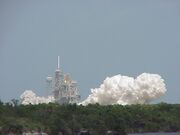 STS-100's engines ignite
 -
 STS-100 Liftoff


Crew seat assignments
| Seat[5] | Launch | Landing | 150px Seats 1–4 are on the flight deck. Seats 5–8 are on the mid-deck. |
|---|---|---|---|
| 1 | Rominger | ||
| 2 | Ashby | ||
| 3 | Hadfield | Guidoni | |
| 4 | Phillips | ||
| 5 | Parazynski | ||
| 6 | Guidoni | Hadfield | |
| 7 | Lonchakov | ||
Spacewalks
| EVA | Spacewalkers | Start (UTC) | End | Duration |
|---|---|---|---|---|
| EVA 1 | Scott Parazynski Chris Hadfield |
22 April 2001 11:45 |
22 April 2001 18:55 |
7 hours 10 minutes |
| Parazynski and Hadfield deployed a UHF antenna on the Destiny lab. After that, the pair began installing the Canadarm2. Parazynski and Hadfield encountered a problem ensuring the proper torque was applied to the bolt. The pair switched the Pistol Grip Tool (PGT) to manual mode and attempted again successfully.
Hadfield experienced severe eye irritation during the spacewalk due to the anti-fog solution used to polish his spacesuit visor, temporarily blinding him and forcing him to vent oxygen into space. Other astronauts experienced a similar problem on subsequent spacewalks.[4] | ||||
| EVA 2 | Parazynski Hadfield |
24 April 2001 12:34 |
24 April 2001 20:14 |
7 hours 40 minutes |
| Connected Power and Data Grapple Fixture (PDGF) circuits for the new arm on Destiny. Removed an early communications antenna and transferred a spare Direct Current Switching Unit (DCSU) from the shuttle's payload bay to an equipment storage rack on the outside of Destiny. | ||||
Wake-up calls
NASA began a tradition of playing music to astronauts during the Gemini program, which was first used to wake up a flight crew during Apollo 15.[6] Each track is specially chosen, often by their families, and usually has a special meaning to an individual member of the crew, or is applicable to their daily activities.[6][7]
| Flight Day | Song | Artist/Composer |
|---|---|---|
| Day 2 | "Then the Morning Comes" | Smash Mouth |
| Day 3 | "Danger Zone" | Kenny Loggins from the soundtrack to Top Gun |
| Day 4 | "Take It From Day to Day" | Stan Rogers |
| Day 5 | "Both Sides Now" | Judy Collins |
| Day 6 | "What a Wonderful World" | Louis Armstrong |
| Day 7 | "Con te Partirò" | Andrea Bocelli |
| Day 8 | "Behind the Fog" | Russian Folk Singer |
| Day 9 | "Buckaroo" | Don Cain |
| Day 10 | "Dangerous" | The Arrogant Worms |
| Day 11 | "Miles From Nowhere" | Cat Stevens |
| Day 12 | "Big Arm on his Ship" | Robinson etc. |
| Day 13 | "True" | Spandau Ballet |
See also
- List of human spaceflights
- List of International Space Station spacewalks
- List of Space Shuttle missions
- List of spacewalks and moonwalks 1965–1999
- Outline of space science
References
- ↑ Wade, Mark. "STS-100". Encyclopedia Astronautica. http://www.astronautix.com/flights/sts100.htm. Retrieved 6 May 2013.
- ↑ 2.0 2.1 2.2 2.3 McDowell, Jonathan. "Satellite Catalog". Jonathan's Space Page. http://planet4589.org/space/log/satcat.txt.
- ↑ "STS-100 Mission Status Report, #20". https://spaceflight.nasa.gov/spacenews/reports/sts100/STS-100-20.html.
- ↑ 4.0 4.1 Hadfield, Chris (2013). An Astronaut's Guide to Life on Earth: What Going to Space Taught Me About Ingenuity, Determination, and Being Prepared for Anything. New York City: Little, Brown and Company. pp. 86–96. ISBN 978-0-316-25301-7.
- ↑ "STS-100". Spacefacts. http://spacefacts.de/mission/english/sts-100.htm.
- ↑ 6.0 6.1 Fries, Colin (25 June 2007). "Chronology of Wakeup Calls". NASA. https://history.nasa.gov/wakeup%20calls.pdf.
- ↑ NASA (11 May 2009). "STS-100 Wakeup Calls". NASA. http://spaceflight.nasa.gov/gallery/audio/shuttle/sts-100/html/ndxpage1.html.
Sources
 This article incorporates public domain material from websites or documents of the National Aeronautics and Space Administration.
External links
| 1998–2004 |
|  | ||||||||||||||||||||||||||||||||||||||||||||||||||||||||
|---|---|---|---|---|---|---|---|---|---|---|---|---|---|---|---|---|---|---|---|---|---|---|---|---|---|---|---|---|---|---|---|---|---|---|---|---|---|---|---|---|---|---|---|---|---|---|---|---|---|---|---|---|---|---|---|---|---|---|
| 2005–2009 | ||||||||||||||||||||||||||||||||||||||||||||||||||||||||||
| 2010–2014 | ||||||||||||||||||||||||||||||||||||||||||||||||||||||||||
| 2015–2019 |
| |||||||||||||||||||||||||||||||||||||||||||||||||||||||||
| 2020–2024 | ||||||||||||||||||||||||||||||||||||||||||||||||||||||||||
| Individuals | ||||||||||||||||||||||||||||||||||||||||||||||||||||||||||
| Vehicles |
| |||||||||||||||||||||||||||||||||||||||||||||||||||||||||
Ongoing spaceflights in bold
! rowspan="3" colspan="2" width="14%" style="border-bottom:2px solid grey;" | Date/Time (UTC) ! Configuration ! Serial number ! Launch site ! Outcome |- |style="text-align:center;background-color:#e3e9e9;" | Payload |style="text-align:center;background-color:#e3e9e9;" | Separation orbit |style="text-align:center;background-color:#e3e9e9;" | Operator |style="text-align:center;background-color:#e3e9e9;" | Function |- | colspan="4" style="text-align:center;background-color:#e4dfdf;border-bottom:2px solid grey;" | Remarks |- Parameter 1=time required!
This is a navigational template created using {{navbox}}. It can be transcluded on pages by placing Initial visibilityThis template's initial visibility currently defaults to To change this template's initial visibility, the
Templates using the classes TemplateDataA navigational box that can be placed at the bottom of articles.
Template transclusions
 Not doneLatin pronunciation: [{{{1}}}] Not doneLatin pronunciation: [{{{1}}}]
| rowspan="1" colspan="2" style="border-top:2px solid #aabbcc;" | | style="border-top:2px solid #aabbcc;" | | style="border-top:2px solid #aabbcc;" | | style="border-top:2px solid #aabbcc;" | | style="border-top:2px solid #aabbcc;" | |- |- Vietnamese pronunciation: [{{{1}}}]-4500 — – -4000 — – -3500 — – -3000 — – -2500 — – -2000 — – -1500 — – -1000 — – -500 — – 0 —  Done Done To doRussian pronunciation: [{{{1}}}]Greek pronunciation: [{{{1}}}] To doRussian pronunciation: [{{{1}}}]Greek pronunciation: [{{{1}}}] Danish pronunciation: [{{{1}}}]Northern Sami pronunciation: [{{{1}}}]Mandarin pronunciation: [{{{ipa}}}]Cantonese pronunciation: [{{{1}}}]Entry from STS-100 from TCI Europe, retrieved on {{{Date}}} Danish pronunciation: [{{{1}}}]Northern Sami pronunciation: [{{{1}}}]Mandarin pronunciation: [{{{ipa}}}]Cantonese pronunciation: [{{{1}}}]Entry from STS-100 from TCI Europe, retrieved on {{{Date}}}
This is a navigational template created using {{navbox}}. It can be transcluded on pages by placing Initial visibilityThis template's initial visibility currently defaults to To change this template's initial visibility, the
Templates using the classes TemplateDataA navigational box that can be placed at the bottom of articles.
 In progressPalomares, M. L. D. and Pauly, D., eds. (2011). "{{{1}}} {{{2}}}" in SeaLifeBase. April 2011 version.Turkish pronunciation: [{{{1}}}]Finnish pronunciation: [{{{1}}}]Froese, Rainer and Pauly, Daniel, eds. (2006). "{{{1}}} {{{2}}}" in FishBase. April 2006 version. In progressPalomares, M. L. D. and Pauly, D., eds. (2011). "{{{1}}} {{{2}}}" in SeaLifeBase. April 2011 version.Turkish pronunciation: [{{{1}}}]Finnish pronunciation: [{{{1}}}]Froese, Rainer and Pauly, Daniel, eds. (2006). "{{{1}}} {{{2}}}" in FishBase. April 2006 version.
|- | ... | — | — | — | — | — | — |-Old Norse pronunciation: [{{{1}}}]Salish pronunciation: [{{{1}}}]Basque pronunciation: [{{{1}}}]{{{1}}}data-sort-value="" style="background: #ececec; color: #2C2C2C; vertical-align: middle; font-size: smaller; text-align: center; " class="table-na" | UnreleasedNorwegian pronunciation: [{{{1}}}] (aged {{{4}}})Hungarian pronunciation: [{{{1}}}]Quechua pronunciation: [{{{1}}}]Arabic pronunciation: [{{{1}}}]Punjabi pronunciation: [{{{1}}}]Afrikaans pronunciation: [{{{1}}}]Romanian pronunciation: [{{{1}}}]Hebrew pronunciation: [{{{1}}}][INVALID OR MISSING PARAMETER IN TEMPLATE STS-100]Uto-Aztecan pronunciation: [{{{1}}}]Tamil pronunciation: [{{{1}}}]Hindustani pronunciation: [{{{1}}}]Swedish pronunciation: [{{{1}}}]Kazakh pronunciation: [{{{1}}}]Lao pronunciation: [{{{1}}}]Tibetan pronunciation: [{{{1}}}]Khmer pronunciation: [{{{1}}}]data-sort-value="" style="vertical-align:middle; text-align:center" class="table-na" | —{{{1}}}Welsh pronunciation: [{{{1}}}] Partially doneAthabaskan pronunciation: [{{{1}}}]Māori pronunciation: [{{{1}}}]IPA: [{{{1}}}]Bulgarian pronunciation: [{{{1}}}]Korean pronunciation: [{{{1}}}]Icelandic pronunciation: [{{{1}}}]Sanskrit pronunciation: [{{{1}}}]Bengali pronunciation: [{{{1}}}]Indonesian pronunciation: [{{{1}}}]Serbo-Croatian pronunciation: [{{{1}}}]CROSBI {{{1}}} Future spaceflights in italics Partially doneAthabaskan pronunciation: [{{{1}}}]Māori pronunciation: [{{{1}}}]IPA: [{{{1}}}]Bulgarian pronunciation: [{{{1}}}]Korean pronunciation: [{{{1}}}]Icelandic pronunciation: [{{{1}}}]Sanskrit pronunciation: [{{{1}}}]Bengali pronunciation: [{{{1}}}]Indonesian pronunciation: [{{{1}}}]Serbo-Croatian pronunciation: [{{{1}}}]CROSBI {{{1}}} Future spaceflights in italics
! rowspan="3" colspan="2" width="14%" style="border-bottom:2px solid grey;" | Date/Time (UTC) ! Configuration ! Serial number ! Launch site ! Outcome |- |style="text-align:center;background-color:#e3e9e9;" | Payload |style="text-align:center;background-color:#e3e9e9;" | Separation orbit |style="text-align:center;background-color:#e3e9e9;" | Operator |style="text-align:center;background-color:#e3e9e9;" | Function |- | colspan="4" style="text-align:center;background-color:#e4dfdf;border-bottom:2px solid grey;" | Remarks |- Parameter 1=time required!
This is a navigational template created using {{navbox}}. It can be transcluded on pages by placing Initial visibilityThis template's initial visibility currently defaults to To change this template's initial visibility, the
Templates using the classes TemplateDataA navigational box that can be placed at the bottom of articles.
Template transclusions
Not doneLatin pronunciation: [{{{1}}}]
| rowspan="1" colspan="2" style="border-top:2px solid #aabbcc;" | | style="border-top:2px solid #aabbcc;" | | style="border-top:2px solid #aabbcc;" | | style="border-top:2px solid #aabbcc;" | | style="border-top:2px solid #aabbcc;" | |- |- Vietnamese pronunciation: [{{{1}}}]-4500 — – -4000 — – -3500 — – -3000 — – -2500 — – -2000 — – -1500 — – -1000 — – -500 — – 0 — Done To doRussian pronunciation: [{{{1}}}]Greek pronunciation: [{{{1}}}]Danish pronunciation: [{{{1}}}]Northern Sami pronunciation: [{{{1}}}]Mandarin pronunciation: [{{{ipa}}}]Cantonese pronunciation: [{{{1}}}]Entry from STS-100 from TCI Europe, retrieved on {{{Date}}}
This is a navigational template created using {{navbox}}. It can be transcluded on pages by placing Initial visibilityThis template's initial visibility currently defaults to To change this template's initial visibility, the
Templates using the classes TemplateDataA navigational box that can be placed at the bottom of articles.
In progressPalomares, M. L. D. and Pauly, D., eds. (2011). "{{{1}}} {{{2}}}" in SeaLifeBase. April 2011 version.Turkish pronunciation: [{{{1}}}]Finnish pronunciation: [{{{1}}}]Froese, Rainer and Pauly, Daniel, eds. (2006). "{{{1}}} {{{2}}}" in FishBase. April 2006 version.
|- | ... | — | — | — | — | — | — |-Old Norse pronunciation: [{{{1}}}]Salish pronunciation: [{{{1}}}]Basque pronunciation: [{{{1}}}]{{{1}}}data-sort-value="" style="background: #ececec; color: #2C2C2C; vertical-align: middle; font-size: smaller; text-align: center; " class="table-na" | UnreleasedNorwegian pronunciation: [{{{1}}}] (aged {{{4}}})Hungarian pronunciation: [{{{1}}}]Quechua pronunciation: [{{{1}}}]Arabic pronunciation: [{{{1}}}]Punjabi pronunciation: [{{{1}}}]Afrikaans pronunciation: [{{{1}}}]Romanian pronunciation: [{{{1}}}]Hebrew pronunciation: [{{{1}}}][INVALID OR MISSING PARAMETER IN TEMPLATE STS-100]Uto-Aztecan pronunciation: [{{{1}}}]Tamil pronunciation: [{{{1}}}]Hindustani pronunciation: [{{{1}}}]Swedish pronunciation: [{{{1}}}]Kazakh pronunciation: [{{{1}}}]Lao pronunciation: [{{{1}}}]Tibetan pronunciation: [{{{1}}}]Khmer pronunciation: [{{{1}}}]data-sort-value="" style="vertical-align:middle; text-align:center" class="table-na" | —{{{1}}}Welsh pronunciation: [{{{1}}}] Partially doneAthabaskan pronunciation: [{{{1}}}]Māori pronunciation: [{{{1}}}]IPA: [{{{1}}}]Bulgarian pronunciation: [{{{1}}}]Korean pronunciation: [{{{1}}}]Icelandic pronunciation: [{{{1}}}]Sanskrit pronunciation: [{{{1}}}]Bengali pronunciation: [{{{1}}}]Indonesian pronunciation: [{{{1}}}]Serbo-Croatian pronunciation: [{{{1}}}]CROSBI {{{1}}} † - mission failed to reach ISS | ||||||||||||||||||||||||||||||||||||||||||||||||||||||||||


 |  |

