Engineering:SpaceX Crew-3
 Endurance docked at the ISS | |
| Names | USCV-3 |
|---|---|
| Mission type | ISS crew transport |
| Operator | SpaceX |
| Mission duration | 176 days, 2 hours, 39 minutes, 52 seconds |
| Spacecraft properties | |
| Spacecraft | Crew Dragon |
| Spacecraft type | Crew Dragon |
| Manufacturer | SpaceX |
| Launch mass | 12,055 kg (26,577 lb)[1] |
| Crew | |
| Crew size | 4 |
| Members |
|
| Expedition | Expedition 66/67 |
| Start of mission | |
| Launch date | November 11, 2021, 02:03:31 UTC (November 10, 9:03:31 pm EDT) |
| Rocket | Falcon 9 Block 5 B1067-2 |
| Launch site | Kennedy, LC‑39A |
| End of mission | |
| Recovered by | MV Shannon |
| Landing date | May 6, 2022, 04:43:23 UTC (12:43:23 am EDT)[2] |
| Landing site | Gulf of Mexico, near Clearwater, Florida |
| Orbital parameters | |
| Reference system | Geocentric orbit |
| Regime | Low Earth orbit |
| Inclination | 51.66° |
| Docking with ISS | |
| Docking port | Harmony forward |
| Docking date | November 11, 2021, 23:32 UTC |
| Undocking date | May 5, 2022, 05:20 UTC[2][3] |
| Time docked | 174 days, 5 hours, 48 minutes |
   NASA (left),[4] SpaceX (middle), and ESA (right) mission patches .jpg) From left: Chari, Marshburn, Maurer and Barron | |
SpaceX Crew-3 was the Crew Dragon's third NASA Commercial Crew operational flight, and its fifth overall crewed orbital flight. The mission successfully launched on November 11, 2021, at 02:03:31 UTC to the International Space Station.[5] It was the maiden flight of Crew Dragon Endurance.[6]
This launch brought the total number of humans who have been to space to more than 600 with Maurer (600) and Barron (601).[7]
Name
Crew Dragon capsules have been given names by their initial crews — Endeavour for the first, and Resilience for the second. On October 7, 2021, it was announced that the third capsule will be called Endurance.[8] The name honors the SpaceX and NASA teams that endured through a pandemic, building the spacecraft and training the astronauts who flew it.[9] The name also honors Endurance, the ship used by Shackleton's Imperial Trans-Antarctic Expedition. The three-masted vessel sank in 1915 after being bound in ice before reaching Antarctica.[10]
Crew
German ESA astronaut Matthias Maurer was selected first for the mission in September 2020.[11][12][13] NASA astronauts Raja Chari and Thomas Marshburn were added on December 14, 2020, to the crew.[14][15] The fourth seat was left open in anticipation that a Russian cosmonaut would take the seat, marking the beginning of a barter agreement that would see NASA and Roscosmos trade seats on the Soyuz and Commercial Crew Vehicles, although in April 2021 then-acting NASA administration Steve Jurczyk said that this agreement would be unlikely to start until after Crew-3 had launched.[16] The fourth seat was assigned to Kayla Barron in May 2021.[17]
Chari is the first rookie astronaut to command a NASA space mission since the Skylab 4 crew blasted off to the Skylab space station in 1973. Gerald Carr, who had not flown in space before, led a three-man crew on an 84-day flight on the Skylab.[18] This was also the first spaceflight for Maurer and Barron.[19]
| Position | Astronaut | |
|---|---|---|
| Commander | Raja Chari, NASA Expedition 66/67 First spaceflight | |
| Pilot | Thomas Marshburn, NASA Expedition 66/67 Third and last spaceflight | |
| Mission specialist | Matthias Maurer, ESA Expedition 66/67 First spaceflight | |
| Mission specialist | Kayla Barron, NASA Expedition 66/67 First spaceflight | |
| References:[20][21][12][14][15][17] | ||
| Position | Astronaut | |
|---|---|---|
| Commander | Kjell N. Lindgren, NASA | |
| Pilot | Robert Hines, NASA | |
| Mission specialist | Samantha Cristoforetti, ESA | |
| Mission specialist | Stephanie Wilson, NASA | |
| References:[22][23][24] | ||
The first astronauts of this NASA Astronaut Group 22 (nicknamed The Turtles) to fly to space, Raja Chari and Kayla Barron on SpaceX Crew-3 took a stuffed turtle as zero-g indicator to pay a tribute to their astronaut group.[25] Additionally, to include the other crew members on board, Matthias Maurer and Tom Marshburn the turtle was named "Pfau", a German word meaning "Peacock" for Matthias Maurer, who is German, and for Tom Marshburn, who was part of NASA Astronaut Group 19 (nicknamed The Peacocks).[26]
Mission
The third SpaceX operational mission in the Commercial Crew Program was originally scheduled to launch on October 31, 2021.[27] However, it was delayed to November 3, 2021, due to unfavorable weather in the Atlantic Ocean,[28] and then further delayed to November 7, 2021, due to a minor medical issue with one of the astronauts.[29] Due to expected bad weather, it was again delayed to November 9, 2021.[30]
Due to the launch delays, NASA decided to return the astronauts from Crew-2 before Crew-3 launched, thus being the first Crew Dragon indirect handover of space station crews.[31] SpaceX Crew-2 departed the station on November 8, 2021, and splashed down on November 9, 2021. SpaceX Crew-3 mission launched from Cape Canaveral on November 11, 2021, at 02:03:31 UTC.[32]
The return of Crew-3 was delayed multiple times, from April 2022 to early May. Undocking happened on May 5 (05:20 UTC), with splashdown occurring the following day after spending 176 days in space.[33]
The European segment of the mission is called "Cosmic Kiss".[34]
Gallery
-
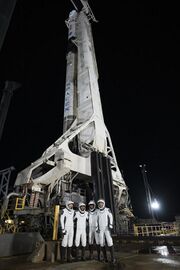 Crew-3 astronauts during dress rehearsals
 -
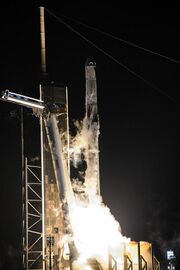 Launch of Crew-3
 -
 Crew Dragon approaches the ISS
 -
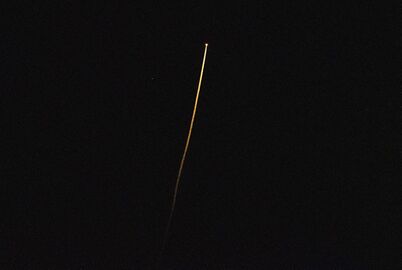 Crew-3 reenters the atmosphere
 -
 Crew Dragon Endurance on MV Shannon after splashdown
 -
 Crew-3 astronauts after splashdown
.jpg)
.jpg)
.jpg)
.jpg)
.jpg)
.jpg)
See also
- Dragon C206 Endeavour
- Dragon C207 Resilience
- Dragon C210 Endurance
- Dragon C212 Freedom
References
- ↑ "Dragon Endurance". NASA. November 14, 2021. https://nssdc.gsfc.nasa.gov/nmc/spacecraft/display.action?id=2021-103A. "Mass: 12055 kg"
- ↑ 2.0 2.1 Kelvey, Jon (May 2, 2022). "Nasa's Crew-3 astronauts set to return to Earth this week" (in en). The Independent. https://www.independent.co.uk/space/nasa-crew3-return-earth-b2069979.html. "Nasa’s head of human spaceflight Kathy Lueders said the space agency aims to have the Crew-3 astronauts undock from the ISS in their Crew Dragon spacecraft around pm EDT on Wednesday 4 May, with a splashdown off the Florida coast to follow on 5 May."
- ↑ Kanayama, Lee (April 27, 2022). "Crew Dragon Freedom makes its first docking at the ISS on the Crew-4 mission". NASASpaceFlight.com. https://www.nasaspaceflight.com/2022/04/dragon-freedom-docks-crew-4/. "This handover is expected to be complete by May 4, when Endurance is slated to depart the ISS, however this timeline will be contingent on recovery weather conditions."
- ↑ Manchess, Gregory (May 19, 2021). "SpaceX Dragon Crew 3 Patch Design". https://www.muddycolors.com/2021/05/spacex-dragon-crew-3-patch-design/.
- ↑ "SpaceX debuts new Dragon capsule in launch to the International Space Station". Spaceflight Now. November 11, 2021. https://spaceflightnow.com/2021/11/11/spacex-debuts-new-dragon-capsule-in-launch-to-the-international-space-station/.
- ↑ Clark, Stephen. "Astronauts choose 'Endurance' as name for new SpaceX crew capsule – Spaceflight Now" (in en-US). https://spaceflightnow.com/2021/10/08/astronauts-choose-endurance-as-name-for-new-spacex-crew-capsule/.
- ↑ Roulette, Joey (November 10, 2021). "More than 600 human beings have now been to space". https://www.nytimes.com/2021/11/10/science/600-astronauts-space.html. "They've tipped the number of people to have gone to space to over 600, according to a tally maintained by NASA"
- ↑ NASA's SpaceX Crew1 Post-Splashdown Briefing. NASA Video. May 2, 2021. Archived from the original on October 10, 2021. Retrieved November 2, 2021 – via YouTube.
 This article incorporates text from this source, which is in the public domain.
- ↑ Wall, Mike (October 7, 2021). "Meet "Endurance": New SpaceX Crew Dragon capsule gets a name". Space.com. https://www.space.com/spacex-crew-dragon-capsule-named-endurance.
- ↑ "Astronauts choose "Endurance" as name for new SpaceX crew capsule". Spaceflight Now. October 8, 2021. https://spaceflightnow.com/2021/10/08/astronauts-choose-endurance-as-name-for-new-spacex-crew-capsule/.
- ↑ Brown, Mike (October 1, 2020). "SpaceX and NASA Detail a Packed 12 months for Crew Dragon: What to Know". Inverse. https://www.inverse.com/innovation/spacex-crew-dragon-nasa-flights.
- ↑ 12.0 12.1 Becker, Joachim Wilhelm Josef (November 13, 2020). "Spaceflight mission report: SpaceX Crew-3". Space Facts. https://www.spacefacts.de/mission/english/crew-3.htm.
- ↑ Crewed Spaceflight Tweets [@MannedTweets] (September 8, 2020). "BREAKING NEWS ‼ Michal Vaclavik, Czech representative at ESA: Now baked at ESA. It is clear that ESA astronaut Thomas Pesquet will fly on Crew-2, but we have now agreed that another ESA astronaut, Matthias Maurer, will fly to Crew-3 in September 2021. @ShuttleAlmanac t.co/lQ7LPYfaDp". https://twitter.com/MannedTweets/status/1303464156620873728.
- ↑ 14.0 14.1 Potter, Sean (December 14, 2020). "NASA, ESA Choose Astronauts for SpaceX Crew-3 Mission to Space Station". NASA. http://www.nasa.gov/press-release/nasa-esa-choose-astronauts-for-spacex-crew-3-mission-to-space-station. This article incorporates text from this source, which is in the public domain.
- ↑ 15.0 15.1 Clark, Stephen (December 29, 2020). "Three astronauts assigned to Crew Dragon mission in late 2021". Spaceflight Now. https://spaceflightnow.com/2020/12/29/three-astronauts-assigned-to-crew-dragon-mission-in-late-2021/.
- ↑ Clark, Stephen. "NASA chief: Russian cosmonauts unlikely fly on U.S. crew capsules until next year". Spaceflight Now. https://spaceflightnow.com/2021/04/20/nasa-chief-russian-cosmonauts-unlikely-fly-on-u-s-crew-capsules-until-next-year/..
- ↑ 17.0 17.1 "Kayla Barron Joins NASA's SpaceX Crew-3 Mission to Space Station". NASA. May 17, 2021. https://www.nasa.gov/press-release/kayla-barron-joins-nasa-s-spacex-crew-3-mission-to-space-station. This article incorporates text from this source, which is in the public domain.
- ↑ "Raja Chari is the first rookie astronaut in 48 years to command a NASA mission". Spaceflight Now. November 10, 2021. https://spaceflightnow.com/2021/11/10/raja-chari-is-the-first-rookie-astronaut-in-nearly-50-years-to-command-a-nasa-mission/.
- ↑ "SpaceX launches mostly-rookie Crew-3 mission to ISS". November 10, 2021. https://www.nasaspaceflight.com/2021/11/crew-3-launch/.
- ↑ "JSR 799 draft". Jonathan's Space Report. November 10, 2021. https://www.planet4589.org/latest.html.
- ↑ "NASA assigns astronauts for third SpaceX commercial crew mission". SpaceNews. December 14, 2020. https://spacenews.com/nasa-assigns-astronauts-for-third-spacex-commercial-crew-mission/.
- ↑ Whiting, Melanie (March 7, 2016). "Kjell N. Lindgren (M.D.) NASA Astronaut". NASA. https://www.nasa.gov/astronauts/biographies/kjell-n-lindgren/biography. This article incorporates text from this source, which is in the public domain.
- ↑ "Robert Hines NASA Astronaut". NASA. April 26, 2021. https://www.nasa.gov/content/astronaut-candidate-bob-hines. This article incorporates text from this source, which is in the public domain.
- ↑ Marshburn, Thomas [@AstroMarshburn] (June 12, 2021). "Had a great week in Cologne, Germany, home of our crewmate @astro_matthias Our backup, @Astro_Stephanie joined us for our final training trip to the European Space Agency before we launch this fall! t.co/Zn8TaDn9NK". https://twitter.com/AstroMarshburn/status/1403769065194274818.
- ↑ "SpaceX Crew-3". Twitter. https://twitter.com/sciguyspace/status/1458620101784129547.
- ↑ "Crew-3 Mission". November 11, 2021. https://www.youtube.com/watch?v=aknndyovSKs.
- ↑ Sempsrott, Danielle (October 19, 2021). "NASA, SpaceX Adjust Next Crew Launch Date to Space Station". NASA. https://blogs.nasa.gov/commercialcrew/2021/10/19/nasa-spacex-adjust-next-crew-launch-date-to-space-station. This article incorporates text from this source, which is in the public domain.
- ↑ Sempsrott, Danielle (October 30, 2021). "NASA, SpaceX Adjust Next Space Station Crew Rotation Launch Date". NASA. https://blogs.nasa.gov/commercialcrew/2021/10/30/nasa-spacex-adjust-next-space-station-crew-rotation-launch-date-2/. This article incorporates text from this source, which is in the public domain.
- ↑ "SpaceX's Crew-3 astronaut launch for NASA delayed by "minor medical issue"". Space.com. November 1, 2021. https://www.space.com/spacex-crew-3-launch-astronaut-medical-issue-delay.
- ↑ "NASA rules out weekend Crew Dragon launch, may bring station crew home first". Spaceflight Now. November 4, 2021. https://spaceflightnow.com/2021/11/04/nasa-rules-out-weekend-crew-dragon-launch-may-bring-station-crew-home-first/.
- ↑ "SpaceX crew launch bumped to next week; astronaut on mend". November 4, 2021. https://apnews.com/article/space-exploration-science-business-weather-26ca18622d5779b79aeac5bc41392cbe.
- ↑ "Forum Crew-3". NASASpaceFlight.com. November 5, 2021. https://forum.nasaspaceflight.com/index.php?topic=51899.msg2307149;topicseen#new.
- ↑ "SpaceX's Crew-3 astronaut mission will return to Earth early Friday morning" (in en). May 3, 2022. https://www.space.com/spacex-crew3-mission-return-to-earth-friday.
- ↑ "ESA astronaut Matthias Maurer officially assigned first flight". ESA. December 14, 2020. https://www.esa.int/Science_Exploration/Human_and_Robotic_Exploration/ESA_astronaut_Matthias_Maurer_officially_assigned_first_flight.
| 1998–2004 |
|  | ||||||||||||||||||||||||||||||||||||||||||||||||||||||||
|---|---|---|---|---|---|---|---|---|---|---|---|---|---|---|---|---|---|---|---|---|---|---|---|---|---|---|---|---|---|---|---|---|---|---|---|---|---|---|---|---|---|---|---|---|---|---|---|---|---|---|---|---|---|---|---|---|---|---|
| 2005–2009 | ||||||||||||||||||||||||||||||||||||||||||||||||||||||||||
| 2010–2014 | ||||||||||||||||||||||||||||||||||||||||||||||||||||||||||
| 2015–2019 |
| |||||||||||||||||||||||||||||||||||||||||||||||||||||||||
| 2020–2024 | ||||||||||||||||||||||||||||||||||||||||||||||||||||||||||
| Individuals | ||||||||||||||||||||||||||||||||||||||||||||||||||||||||||
| Vehicles |
| |||||||||||||||||||||||||||||||||||||||||||||||||||||||||
Ongoing spaceflights in bold
! rowspan="3" colspan="2" width="14%" style="border-bottom:2px solid grey;" | Date/Time (UTC) ! Configuration ! Serial number ! Launch site ! Outcome |- |style="text-align:center;background-color:#e3e9e9;" | Payload |style="text-align:center;background-color:#e3e9e9;" | Separation orbit |style="text-align:center;background-color:#e3e9e9;" | Operator |style="text-align:center;background-color:#e3e9e9;" | Function |- | colspan="4" style="text-align:center;background-color:#e4dfdf;border-bottom:2px solid grey;" | Remarks |- Parameter 1=time required!
This is a navigational template created using {{navbox}}. It can be transcluded on pages by placing Initial visibilityThis template's initial visibility currently defaults to To change this template's initial visibility, the
Templates using the classes TemplateDataA navigational box that can be placed at the bottom of articles.
Template transclusions
 Not doneLatin pronunciation: [{{{1}}}] Not doneLatin pronunciation: [{{{1}}}]
| rowspan="1" colspan="2" style="border-top:2px solid #aabbcc;" | | style="border-top:2px solid #aabbcc;" | | style="border-top:2px solid #aabbcc;" | | style="border-top:2px solid #aabbcc;" | | style="border-top:2px solid #aabbcc;" | |- |- Vietnamese pronunciation: [{{{1}}}]-4500 — – -4000 — – -3500 — – -3000 — – -2500 — – -2000 — – -1500 — – -1000 — – -500 — – 0 —  Done Done To doRussian pronunciation: [{{{1}}}]Greek pronunciation: [{{{1}}}] To doRussian pronunciation: [{{{1}}}]Greek pronunciation: [{{{1}}}] Danish pronunciation: [{{{1}}}]Northern Sami pronunciation: [{{{1}}}]Mandarin pronunciation: [{{{ipa}}}]Cantonese pronunciation: [{{{1}}}]Entry from SpaceX Crew-3 from TCI Europe, retrieved on {{{Date}}} Danish pronunciation: [{{{1}}}]Northern Sami pronunciation: [{{{1}}}]Mandarin pronunciation: [{{{ipa}}}]Cantonese pronunciation: [{{{1}}}]Entry from SpaceX Crew-3 from TCI Europe, retrieved on {{{Date}}}
This is a navigational template created using {{navbox}}. It can be transcluded on pages by placing Initial visibilityThis template's initial visibility currently defaults to To change this template's initial visibility, the
Templates using the classes TemplateDataA navigational box that can be placed at the bottom of articles.
 In progressPalomares, M. L. D. and Pauly, D., eds. (2011). "{{{1}}} {{{2}}}" in SeaLifeBase. April 2011 version.Turkish pronunciation: [{{{1}}}]Finnish pronunciation: [{{{1}}}]Froese, Rainer and Pauly, Daniel, eds. (2006). "{{{1}}} {{{2}}}" in FishBase. April 2006 version. In progressPalomares, M. L. D. and Pauly, D., eds. (2011). "{{{1}}} {{{2}}}" in SeaLifeBase. April 2011 version.Turkish pronunciation: [{{{1}}}]Finnish pronunciation: [{{{1}}}]Froese, Rainer and Pauly, Daniel, eds. (2006). "{{{1}}} {{{2}}}" in FishBase. April 2006 version.
|- | ... | — | — | — | — | — | — |-Old Norse pronunciation: [{{{1}}}]Salish pronunciation: [{{{1}}}]Basque pronunciation: [{{{1}}}]{{{1}}}data-sort-value="" style="background: #ececec; color: #2C2C2C; vertical-align: middle; font-size: smaller; text-align: center; " class="table-na" | UnreleasedNorwegian pronunciation: [{{{1}}}] (aged {{{4}}})Hungarian pronunciation: [{{{1}}}]Quechua pronunciation: [{{{1}}}]Arabic pronunciation: [{{{1}}}]Punjabi pronunciation: [{{{1}}}]Afrikaans pronunciation: [{{{1}}}]Romanian pronunciation: [{{{1}}}]Hebrew pronunciation: [{{{1}}}][INVALID OR MISSING PARAMETER IN TEMPLATE SpaceX Crew-3]Uto-Aztecan pronunciation: [{{{1}}}]Tamil pronunciation: [{{{1}}}]Hindustani pronunciation: [{{{1}}}]Swedish pronunciation: [{{{1}}}]Kazakh pronunciation: [{{{1}}}]Lao pronunciation: [{{{1}}}]Tibetan pronunciation: [{{{1}}}]Khmer pronunciation: [{{{1}}}]data-sort-value="" style="vertical-align:middle; text-align:center" class="table-na" | —{{{1}}}Welsh pronunciation: [{{{1}}}] Partially doneAthabaskan pronunciation: [{{{1}}}]Māori pronunciation: [{{{1}}}]IPA: [{{{1}}}]Bulgarian pronunciation: [{{{1}}}]Korean pronunciation: [{{{1}}}]Icelandic pronunciation: [{{{1}}}]Sanskrit pronunciation: [{{{1}}}]Bengali pronunciation: [{{{1}}}]Indonesian pronunciation: [{{{1}}}]Serbo-Croatian pronunciation: [{{{1}}}]CROSBI {{{1}}} Future spaceflights in italics Partially doneAthabaskan pronunciation: [{{{1}}}]Māori pronunciation: [{{{1}}}]IPA: [{{{1}}}]Bulgarian pronunciation: [{{{1}}}]Korean pronunciation: [{{{1}}}]Icelandic pronunciation: [{{{1}}}]Sanskrit pronunciation: [{{{1}}}]Bengali pronunciation: [{{{1}}}]Indonesian pronunciation: [{{{1}}}]Serbo-Croatian pronunciation: [{{{1}}}]CROSBI {{{1}}} Future spaceflights in italics
! rowspan="3" colspan="2" width="14%" style="border-bottom:2px solid grey;" | Date/Time (UTC) ! Configuration ! Serial number ! Launch site ! Outcome |- |style="text-align:center;background-color:#e3e9e9;" | Payload |style="text-align:center;background-color:#e3e9e9;" | Separation orbit |style="text-align:center;background-color:#e3e9e9;" | Operator |style="text-align:center;background-color:#e3e9e9;" | Function |- | colspan="4" style="text-align:center;background-color:#e4dfdf;border-bottom:2px solid grey;" | Remarks |- Parameter 1=time required!
This is a navigational template created using {{navbox}}. It can be transcluded on pages by placing Initial visibilityThis template's initial visibility currently defaults to To change this template's initial visibility, the
Templates using the classes TemplateDataA navigational box that can be placed at the bottom of articles.
Template transclusions
Not doneLatin pronunciation: [{{{1}}}]
| rowspan="1" colspan="2" style="border-top:2px solid #aabbcc;" | | style="border-top:2px solid #aabbcc;" | | style="border-top:2px solid #aabbcc;" | | style="border-top:2px solid #aabbcc;" | | style="border-top:2px solid #aabbcc;" | |- |- Vietnamese pronunciation: [{{{1}}}]-4500 — – -4000 — – -3500 — – -3000 — – -2500 — – -2000 — – -1500 — – -1000 — – -500 — – 0 — Done To doRussian pronunciation: [{{{1}}}]Greek pronunciation: [{{{1}}}]Danish pronunciation: [{{{1}}}]Northern Sami pronunciation: [{{{1}}}]Mandarin pronunciation: [{{{ipa}}}]Cantonese pronunciation: [{{{1}}}]Entry from SpaceX Crew-3 from TCI Europe, retrieved on {{{Date}}}
This is a navigational template created using {{navbox}}. It can be transcluded on pages by placing Initial visibilityThis template's initial visibility currently defaults to To change this template's initial visibility, the
Templates using the classes TemplateDataA navigational box that can be placed at the bottom of articles.
In progressPalomares, M. L. D. and Pauly, D., eds. (2011). "{{{1}}} {{{2}}}" in SeaLifeBase. April 2011 version.Turkish pronunciation: [{{{1}}}]Finnish pronunciation: [{{{1}}}]Froese, Rainer and Pauly, Daniel, eds. (2006). "{{{1}}} {{{2}}}" in FishBase. April 2006 version.
|- | ... | — | — | — | — | — | — |-Old Norse pronunciation: [{{{1}}}]Salish pronunciation: [{{{1}}}]Basque pronunciation: [{{{1}}}]{{{1}}}data-sort-value="" style="background: #ececec; color: #2C2C2C; vertical-align: middle; font-size: smaller; text-align: center; " class="table-na" | UnreleasedNorwegian pronunciation: [{{{1}}}] (aged {{{4}}})Hungarian pronunciation: [{{{1}}}]Quechua pronunciation: [{{{1}}}]Arabic pronunciation: [{{{1}}}]Punjabi pronunciation: [{{{1}}}]Afrikaans pronunciation: [{{{1}}}]Romanian pronunciation: [{{{1}}}]Hebrew pronunciation: [{{{1}}}][INVALID OR MISSING PARAMETER IN TEMPLATE SpaceX Crew-3]Uto-Aztecan pronunciation: [{{{1}}}]Tamil pronunciation: [{{{1}}}]Hindustani pronunciation: [{{{1}}}]Swedish pronunciation: [{{{1}}}]Kazakh pronunciation: [{{{1}}}]Lao pronunciation: [{{{1}}}]Tibetan pronunciation: [{{{1}}}]Khmer pronunciation: [{{{1}}}]data-sort-value="" style="vertical-align:middle; text-align:center" class="table-na" | —{{{1}}}Welsh pronunciation: [{{{1}}}] Partially doneAthabaskan pronunciation: [{{{1}}}]Māori pronunciation: [{{{1}}}]IPA: [{{{1}}}]Bulgarian pronunciation: [{{{1}}}]Korean pronunciation: [{{{1}}}]Icelandic pronunciation: [{{{1}}}]Sanskrit pronunciation: [{{{1}}}]Bengali pronunciation: [{{{1}}}]Indonesian pronunciation: [{{{1}}}]Serbo-Croatian pronunciation: [{{{1}}}]CROSBI {{{1}}} † - mission failed to reach ISS | ||||||||||||||||||||||||||||||||||||||||||||||||||||||||||


Template:SpaceX Dragon Template:SpaceX missions and payloads
 |  |


