Astronomy:SpaceX Crew-4
.jpg) Freedom launches to the ISS with the crew members of Crew-4 onboard. | |
| Names | USCV-4 |
|---|---|
| Mission type | ISS crew transport |
| Operator | SpaceX |
| Mission duration | 170 days, 13 hours, 2 minutes, 32 seconds[1][2] |
| Spacecraft properties | |
| Spacecraft | Crew Dragon |
| Spacecraft type | Crew Dragon |
| Manufacturer | SpaceX |
| Launch mass | 12,519 kg (27,600 lb) |
| Landing mass | 9,616 kg (21,200 lb) |
| Crew | |
| Crew size | 4 |
| Members |
|
| Expedition | Expedition 67/68 |
| Start of mission | |
| Launch date | April 27, 2022, 07:52:55 UTC (3:52:55 am EDT)[3] |
| Rocket | Falcon 9 Block 5 B1067-4 |
| Launch site | Kennedy, LC‑39A |
| End of mission | |
| Recovered by | MV Megan |
| Landing date | October 14, 2022, 20:55:27 UTC (4:55:27 pm EDT) |
| Landing site | Atlantic Ocean, near Jacksonville, Florida[4] |
| Orbital parameters | |
| Reference system | Geocentric orbit |
| Regime | Low Earth orbit |
| Inclination | 51.64° |
| Docking with ISS | |
| Docking port | Harmony zenith |
| Docking date | April 27, 2022, 23:37 UTC |
| Undocking date | October 14, 2022, 16:05 UTC[5] |
| Time docked | 169 days, 16 hours, 28 minutes |
 File:SpaceX Crew-4 mission patch.png File:SpaceX Crew-4 ESA mission patch.png File:SpaceX Crew-4 mission patch.png File:SpaceX Crew-4 ESA mission patch.pngNASA (left), SpaceX (middle), and ESA (right) mission patches  From left: Hines, Cristoforetti, Watkins and Lindgren | |
SpaceX Crew-4 was the Crew Dragon's fourth NASA Commercial Crew operational flight, and its seventh overall crewed orbital flight. The mission launched on April 27, 2022, at 07:52 UTC[6] before docking with the International Space Station (ISS) at 23:37 UTC. It followed shortly after the private Axiom 1 mission to the ISS earlier in the month utilizing SpaceX hardware. Three American (NASA) astronauts and one European (ESA) astronaut were on board the mission.[7][8][9]
Crew-4 was the maiden flight of the Crew Dragon spacecraft named Freedom, named such by the crew because it "celebrates a fundamental human right, and the industry and innovation that emanate from the unencumbered human spirit".[10] The booster used on this mission was the B1067, which makes it the first Commercial Crew mission to use a booster on its fourth flight (it previously was used to launch SpaceX Crew-3 in 2021).[11]
Crew
NASA astronauts Kjell Lindgren and Robert Hines were announced on February 12, 2021, to the crew.[7][8] Samantha Cristoforetti was named the commander of Expedition 68 on May 28, 2021.[12] Jessica Watkins was named mission specialist on November 16, 2021.[13] Cristoforetti was later removed as commander of Expedition 68 due to the shortening of the Crew-4 mission.[14]
| Position | Astronaut | |
|---|---|---|
| Commander | Kjell N. Lindgren, NASA Expedition 67/68 Second spaceflight | |
| Pilot | Robert Hines, NASA Expedition 67/68 First spaceflight | |
| Mission specialist | Samantha Cristoforetti, ESA Expedition 67/68 Second spaceflight | |
| Mission specialist | Jessica Watkins, NASA Expedition 67/68 First spaceflight | |
| Position[15] | Astronaut | |
|---|---|---|
| Commander | Steve Bowen, NASA | |
Mission
The mission duration was 170 days.[4] The European part of the mission was called Minerva,[16] named after the Roman goddess of wisdom,[17] and it was European astronaut Cristoforetti's second mission to the ISS.
Gallery
-
Crew-4 astronauts before flight
-
ISS configuration during Crew-4
-
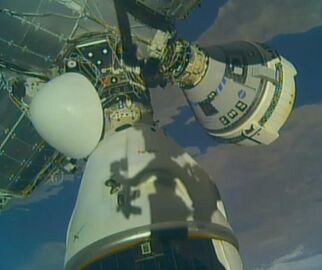 Crew-4 and Starliner OFT-2 docked to the ISS
 -
 Freedom after reentry and splashdown

.jpeg)
See also
References
- ↑ Sheetz, Michael (April 27, 2022). "SpaceX launches Crew-4 mission for NASA, has now sent 26 astronauts to space in under two years". CNBC. https://www.cnbc.com/2022/04/27/elon-musks-spacex-launches-nasa-crew-4-astronaut-mission.html.
- ↑ NASA (2022). "Crew-4 Mission Overview". p. 1. https://www.nasa.gov/sites/default/files/atoms/files/crew-4_mission_overview.pdf. "Crew-4 is scheduled for a long duration stay of up to six months aboard station conducting science and maintenance before returning to Earth in the fall of 2022."
- ↑ Garcia, Mark (April 27, 2022). "SpaceX Crew-4 Launches to Join Station Crew Tonight". https://blogs.nasa.gov/spacestation/2022/04/27/spacex-crew-4-launches-to-join-station-crew-tonight/.
- ↑ 4.0 4.1 Garcia, Mark (October 14, 2022). "SpaceX Crew-4 Returns with Splashdown on Florida's Atlantic Coast". https://blogs.nasa.gov/crew-4/2022/10/14/spacex-crew-4-returns-with-splashdown-on-floridas-atlantic-coast/.
- ↑ Wall, Mike (October 14, 2022). "SpaceX's Crew-4 mission leaves space station and heads for home". https://www.space.com/spacex-crew-4-mission-departs-space-station. "Crew-4's Dragon capsule, named Freedom, undocked from the International Space Station (ISS) on Friday (Oct. 14) at 12:05 p.m. EDT (1605 GMT)"
- ↑ Griffin, Amanda (April 22, 2022). "NASA and SpaceX Adjust Agency's Crew-4 Launch Date". NASA. https://blogs.nasa.gov/commercialcrew/2022/04/22/nasa-and-spacex-adjust-agencys-crew-4-launch-date/.
- ↑ 7.0 7.1 Finch, Joshua (April 25, 2022). "Coverage Updated for NASA's SpaceX Crew-4 Briefing, Events, Broadcast". NASA. https://www.nasa.gov/press-release/coverage-updated-for-nasa-s-spacex-crew-4-briefing-events-broadcast.
 This article incorporates text from this source, which is in the public domain.
- ↑ 8.0 8.1 Howell, Elizabeth (February 23, 2021). "These 2 NASA astronauts will fly on SpaceX's Crew-4 mission to the International Space Station in 2022". Space.com. https://www.space.com/spacex-crew-4-astronaut-assignments.
- ↑ Ellis, Kathleen (March 18, 2022). "NASA, SpaceX Adjust Target Launch Date for Crew-4 Mission". NASA. https://blogs.nasa.gov/commercialcrew/2022/03/18/nasa-spacex-adjust-target-launch-date-for-crew-4-mission/.
- ↑ Klotz, Irene (October 6, 2021). "Forum - Crew-4". NASASpaceFlight.com. p. 2. https://forum.nasaspaceflight.com/index.php?topic=52608.msg2311210#msg2311210.
- ↑ @jeff_foust (January 19, 2022). "Steve Stich says the Crew-4 flight will be the first commercial crew mission using a booster on its fourth flight.". https://twitter.com/jeff_foust/status/1483820173933137932.
- ↑ "Commanding role for ESA astronaut Samantha Cristoforetti". ESA. May 28, 2021. https://www.esa.int/Science_Exploration/Human_and_Robotic_Exploration/Commanding_role_for_ESA_astronaut_Samantha_Cristoforetti.
- ↑ "NASA Assigns Astronaut Jessica Watkins to NASA's SpaceX Crew-4 Mission". NASA. November 16, 2021. https://www.nasa.gov/press-release/nasa-assigns-astronaut-jessica-watkins-to-nasa-s-spacex-crew-4-mission. This article incorporates text from this source, which is in the public domain.
- ↑ "Revised flight plan brings change for Samantha". ESA. March 2, 2021. https://www.esa.int/Science_Exploration/Human_and_Robotic_Exploration/Revised_flight_plan_brings_change_for_Samantha.
- ↑ "Stephen G. Bowen (Captain, USN, Ret.) NASA Astronaut". NASA. April 26, 2021. https://www.nasa.gov/astronauts/biographies/stephen-g-bowen/biography. This article incorporates text from this source, which is in the public domain.
- ↑ "Minerva: ESA astronaut Samantha Cristoforetti's second mission to the International Space Station". ESA. https://www.esa.int/Science_Exploration/Human_and_Robotic_Exploration/Minerva.
- ↑ "Minerva patch explained". March 3, 2022. https://www.esa.int/ESA_Multimedia/Images/2022/03/Minerva_patch_explained. "Inspired by the Roman goddess of wisdom, the handicrafts and the arts, the name Minerva is a homage to the competence and sophisticated craftmanship of the men and women all over the world who make human spaceflight possible."
| 1998–2004 |
|  | ||||||||||||||||||||||||||||||||||||||||||||||||||||||||
|---|---|---|---|---|---|---|---|---|---|---|---|---|---|---|---|---|---|---|---|---|---|---|---|---|---|---|---|---|---|---|---|---|---|---|---|---|---|---|---|---|---|---|---|---|---|---|---|---|---|---|---|---|---|---|---|---|---|---|
| 2005–2009 | ||||||||||||||||||||||||||||||||||||||||||||||||||||||||||
| 2010–2014 | ||||||||||||||||||||||||||||||||||||||||||||||||||||||||||
| 2015–2019 |
| |||||||||||||||||||||||||||||||||||||||||||||||||||||||||
| 2020–2024 | ||||||||||||||||||||||||||||||||||||||||||||||||||||||||||
| Individuals | ||||||||||||||||||||||||||||||||||||||||||||||||||||||||||
| Vehicles |
| |||||||||||||||||||||||||||||||||||||||||||||||||||||||||
Ongoing spaceflights in bold
! rowspan="3" colspan="2" width="14%" style="border-bottom:2px solid grey;" | Date/Time (UTC) ! Configuration ! Serial number ! Launch site ! Outcome |- |style="text-align:center;background-color:#e3e9e9;" | Payload |style="text-align:center;background-color:#e3e9e9;" | Separation orbit |style="text-align:center;background-color:#e3e9e9;" | Operator |style="text-align:center;background-color:#e3e9e9;" | Function |- | colspan="4" style="text-align:center;background-color:#e4dfdf;border-bottom:2px solid grey;" | Remarks |- Parameter 1=time required!
This is a navigational template created using {{navbox}}. It can be transcluded on pages by placing Initial visibilityThis template's initial visibility currently defaults to To change this template's initial visibility, the
Templates using the classes TemplateDataA navigational box that can be placed at the bottom of articles.
Template transclusions
 Not doneLatin pronunciation: [{{{1}}}] Not doneLatin pronunciation: [{{{1}}}]
| rowspan="1" colspan="2" style="border-top:2px solid #aabbcc;" | | style="border-top:2px solid #aabbcc;" | | style="border-top:2px solid #aabbcc;" | | style="border-top:2px solid #aabbcc;" | | style="border-top:2px solid #aabbcc;" | |- |- Vietnamese pronunciation: [{{{1}}}]-4500 — – -4000 — – -3500 — – -3000 — – -2500 — – -2000 — – -1500 — – -1000 — – -500 — – 0 —  Done Done To doRussian pronunciation: [{{{1}}}]Greek pronunciation: [{{{1}}}] To doRussian pronunciation: [{{{1}}}]Greek pronunciation: [{{{1}}}] Danish pronunciation: [{{{1}}}]Northern Sami pronunciation: [{{{1}}}]Mandarin pronunciation: [{{{ipa}}}]Cantonese pronunciation: [{{{1}}}]Entry from SpaceX Crew-4 from TCI Europe, retrieved on {{{Date}}} Danish pronunciation: [{{{1}}}]Northern Sami pronunciation: [{{{1}}}]Mandarin pronunciation: [{{{ipa}}}]Cantonese pronunciation: [{{{1}}}]Entry from SpaceX Crew-4 from TCI Europe, retrieved on {{{Date}}}
This is a navigational template created using {{navbox}}. It can be transcluded on pages by placing Initial visibilityThis template's initial visibility currently defaults to To change this template's initial visibility, the
Templates using the classes TemplateDataA navigational box that can be placed at the bottom of articles.
 In progressPalomares, M. L. D. and Pauly, D., eds. (2011). "{{{1}}} {{{2}}}" in SeaLifeBase. April 2011 version.Turkish pronunciation: [{{{1}}}]Finnish pronunciation: [{{{1}}}]Froese, Rainer and Pauly, Daniel, eds. (2006). "{{{1}}} {{{2}}}" in FishBase. April 2006 version. In progressPalomares, M. L. D. and Pauly, D., eds. (2011). "{{{1}}} {{{2}}}" in SeaLifeBase. April 2011 version.Turkish pronunciation: [{{{1}}}]Finnish pronunciation: [{{{1}}}]Froese, Rainer and Pauly, Daniel, eds. (2006). "{{{1}}} {{{2}}}" in FishBase. April 2006 version.
|- | ... | — | — | — | — | — | — |-Old Norse pronunciation: [{{{1}}}]Salish pronunciation: [{{{1}}}]Basque pronunciation: [{{{1}}}]{{{1}}}data-sort-value="" style="background: #ececec; color: #2C2C2C; vertical-align: middle; font-size: smaller; text-align: center; " class="table-na" | UnreleasedNorwegian pronunciation: [{{{1}}}] (aged {{{4}}})Hungarian pronunciation: [{{{1}}}]Quechua pronunciation: [{{{1}}}]Arabic pronunciation: [{{{1}}}]Punjabi pronunciation: [{{{1}}}]Afrikaans pronunciation: [{{{1}}}]Romanian pronunciation: [{{{1}}}]Hebrew pronunciation: [{{{1}}}][INVALID OR MISSING PARAMETER IN TEMPLATE SpaceX Crew-4]Uto-Aztecan pronunciation: [{{{1}}}]Tamil pronunciation: [{{{1}}}]Hindustani pronunciation: [{{{1}}}]Swedish pronunciation: [{{{1}}}]Kazakh pronunciation: [{{{1}}}]Lao pronunciation: [{{{1}}}]Tibetan pronunciation: [{{{1}}}]Khmer pronunciation: [{{{1}}}]data-sort-value="" style="vertical-align:middle; text-align:center" class="table-na" | —{{{1}}}Welsh pronunciation: [{{{1}}}] Partially doneAthabaskan pronunciation: [{{{1}}}]Māori pronunciation: [{{{1}}}]IPA: [{{{1}}}]Bulgarian pronunciation: [{{{1}}}]Korean pronunciation: [{{{1}}}]Icelandic pronunciation: [{{{1}}}]Sanskrit pronunciation: [{{{1}}}]Bengali pronunciation: [{{{1}}}]Indonesian pronunciation: [{{{1}}}]Serbo-Croatian pronunciation: [{{{1}}}]CROSBI {{{1}}} Future spaceflights in italics Partially doneAthabaskan pronunciation: [{{{1}}}]Māori pronunciation: [{{{1}}}]IPA: [{{{1}}}]Bulgarian pronunciation: [{{{1}}}]Korean pronunciation: [{{{1}}}]Icelandic pronunciation: [{{{1}}}]Sanskrit pronunciation: [{{{1}}}]Bengali pronunciation: [{{{1}}}]Indonesian pronunciation: [{{{1}}}]Serbo-Croatian pronunciation: [{{{1}}}]CROSBI {{{1}}} Future spaceflights in italics
! rowspan="3" colspan="2" width="14%" style="border-bottom:2px solid grey;" | Date/Time (UTC) ! Configuration ! Serial number ! Launch site ! Outcome |- |style="text-align:center;background-color:#e3e9e9;" | Payload |style="text-align:center;background-color:#e3e9e9;" | Separation orbit |style="text-align:center;background-color:#e3e9e9;" | Operator |style="text-align:center;background-color:#e3e9e9;" | Function |- | colspan="4" style="text-align:center;background-color:#e4dfdf;border-bottom:2px solid grey;" | Remarks |- Parameter 1=time required!
This is a navigational template created using {{navbox}}. It can be transcluded on pages by placing Initial visibilityThis template's initial visibility currently defaults to To change this template's initial visibility, the
Templates using the classes TemplateDataA navigational box that can be placed at the bottom of articles.
Template transclusions
Not doneLatin pronunciation: [{{{1}}}]
| rowspan="1" colspan="2" style="border-top:2px solid #aabbcc;" | | style="border-top:2px solid #aabbcc;" | | style="border-top:2px solid #aabbcc;" | | style="border-top:2px solid #aabbcc;" | | style="border-top:2px solid #aabbcc;" | |- |- Vietnamese pronunciation: [{{{1}}}]-4500 — – -4000 — – -3500 — – -3000 — – -2500 — – -2000 — – -1500 — – -1000 — – -500 — – 0 — Done To doRussian pronunciation: [{{{1}}}]Greek pronunciation: [{{{1}}}]Danish pronunciation: [{{{1}}}]Northern Sami pronunciation: [{{{1}}}]Mandarin pronunciation: [{{{ipa}}}]Cantonese pronunciation: [{{{1}}}]Entry from SpaceX Crew-4 from TCI Europe, retrieved on {{{Date}}}
This is a navigational template created using {{navbox}}. It can be transcluded on pages by placing Initial visibilityThis template's initial visibility currently defaults to To change this template's initial visibility, the
Templates using the classes TemplateDataA navigational box that can be placed at the bottom of articles.
In progressPalomares, M. L. D. and Pauly, D., eds. (2011). "{{{1}}} {{{2}}}" in SeaLifeBase. April 2011 version.Turkish pronunciation: [{{{1}}}]Finnish pronunciation: [{{{1}}}]Froese, Rainer and Pauly, Daniel, eds. (2006). "{{{1}}} {{{2}}}" in FishBase. April 2006 version.
|- | ... | — | — | — | — | — | — |-Old Norse pronunciation: [{{{1}}}]Salish pronunciation: [{{{1}}}]Basque pronunciation: [{{{1}}}]{{{1}}}data-sort-value="" style="background: #ececec; color: #2C2C2C; vertical-align: middle; font-size: smaller; text-align: center; " class="table-na" | UnreleasedNorwegian pronunciation: [{{{1}}}] (aged {{{4}}})Hungarian pronunciation: [{{{1}}}]Quechua pronunciation: [{{{1}}}]Arabic pronunciation: [{{{1}}}]Punjabi pronunciation: [{{{1}}}]Afrikaans pronunciation: [{{{1}}}]Romanian pronunciation: [{{{1}}}]Hebrew pronunciation: [{{{1}}}][INVALID OR MISSING PARAMETER IN TEMPLATE SpaceX Crew-4]Uto-Aztecan pronunciation: [{{{1}}}]Tamil pronunciation: [{{{1}}}]Hindustani pronunciation: [{{{1}}}]Swedish pronunciation: [{{{1}}}]Kazakh pronunciation: [{{{1}}}]Lao pronunciation: [{{{1}}}]Tibetan pronunciation: [{{{1}}}]Khmer pronunciation: [{{{1}}}]data-sort-value="" style="vertical-align:middle; text-align:center" class="table-na" | —{{{1}}}Welsh pronunciation: [{{{1}}}] Partially doneAthabaskan pronunciation: [{{{1}}}]Māori pronunciation: [{{{1}}}]IPA: [{{{1}}}]Bulgarian pronunciation: [{{{1}}}]Korean pronunciation: [{{{1}}}]Icelandic pronunciation: [{{{1}}}]Sanskrit pronunciation: [{{{1}}}]Bengali pronunciation: [{{{1}}}]Indonesian pronunciation: [{{{1}}}]Serbo-Croatian pronunciation: [{{{1}}}]CROSBI {{{1}}} † - mission failed to reach ISS | ||||||||||||||||||||||||||||||||||||||||||||||||||||||||||


| Past missions |
|  |
|---|---|---|
| Future missions |
| |
| See also | ||
| ||

| General |  .jpg)  .jpg) | ||||||
|---|---|---|---|---|---|---|---|
| Facilities | |||||||
| Earth-based research | |||||||
| Spacecraft used |
| ||||||
| Mission highlights |
| ||||||
 |  |


.png)