Engineering:SpaceX Crew-2
_(cropped).jpg) Endeavour approaches the ISS | |
| Names |
|
|---|---|
| Mission type | ISS crew transport |
| Operator | SpaceX |
| Mission duration | 199 days, 17 hours, 44 minutes, 13 seconds |
| Spacecraft properties | |
| Spacecraft | Crew Dragon C206 Endeavour |
| Spacecraft type | Crew Dragon |
| Manufacturer | SpaceX |
| Launch mass | 12,055 kg (26,577 lb)[1] |
| Landing mass | 9,616 kg (21,200 lb) |
| Crew | |
| Crew size | 4 |
| Members |
|
| Expedition | Expedition 65/66 |
| Start of mission | |
| Launch date | April 23, 2021, 09:49:02 UTC (5:27:17 am EDT)[2] |
| Rocket | Falcon 9 Block 5 B1061-2 |
| Launch site | Kennedy, LC‑39A |
| End of mission | |
| Recovered by | MV GO Navigator |
| Landing date | November 9, 2021, 03:33:15 UTC (10:33:15 am EST) |
| Landing site | Gulf of Mexico, near Pensacola, Florida |
| Orbital parameters | |
| Reference system | Geocentric orbit |
| Regime | Low Earth orbit |
| Inclination | 51.66° |
| Docking with ISS | |
| Docking port | Harmony forward |
| Docking date | April 24, 2021, 09:07:55 UTC |
| Undocking date | July 21, 2021, 10:45 UTC |
| Time docked | 88 days, 1 hour, 37 minutes |
| Docking with ISS (relocation)[lower-alpha 1] | |
| Docking port | Harmony zenith |
| Docking date | July 21, 2021, 11:36 UTC |
| Undocking date | November 8, 2021, 19:05 UTC[5] |
| Time docked | 110 days, 7 hours, 29 minutes |
    From top to bottom, left to right: NASA,[6] SpaceX, JAXA, and ESA mission patches  From left: McArthur, Pesquet, Hoshide and Kimbrough | |
SpaceX Crew-2 was the second operational flight of a Crew Dragon spacecraft, and the third overall crewed orbital flight of the Commercial Crew Program. The mission was launched on April 23, 2021, at 09:49:02 UTC, and docked to the International Space Station on April 24 at 09:08 UTC.[2]
SpaceX Crew-2 used the same capsule as Crew Dragon Demo-2 (Endeavour) and launched on the same Falcon 9 booster as SpaceX Crew-1 (B1061.1).
With its return to Earth the evening of November 9, 2021, the mission set a record for the longest spaceflight by a U.S. crewed spacecraft with a mission duration of 199 days before being surpassed by SpaceX Crew-8 with a mission duration of 235 days respectively.[7]
Crew
On July 28, 2020, JAXA, ESA, and NASA confirmed their astronaut assignments aboard this mission.[8][9]
| Position | Astronaut | |
|---|---|---|
| Commander | Shane Kimbrough, NASA Expedition 65/66 Third and last spaceflight | |
| Pilot | K. Megan McArthur, NASA Expedition 65/66 Second and last spaceflight | |
| Mission specialist | Akihiko Hoshide, JAXA Expedition 65/66 Third spaceflight | |
| Mission specialist | Thomas Pesquet, ESA Expedition 65/66 Second spaceflight | |
| Position | Astronaut | |
|---|---|---|
| Mission specialist | Satoshi Furukawa, JAXA | |
| Mission specialist | Matthias Maurer, ESA | |
German astronaut Matthias Maurer was the backup for Pesquet, while Japanese astronaut Satoshi Furukawa trained as backup to Hoshide.[9][10]
Mission
The second SpaceX operational mission in the Commercial Crew Program launched on April 23, 2021.[11][12] The Crew Dragon Endeavour docked to the International Docking Adapter (IDA) at the forward port of the Harmony module. This was the first mission with astronauts on board to use a previously flown booster launch vehicle.[13][14]
All crew members were veteran astronauts, though this was Megan McArthur's first visit to the ISS (as her first spaceflight was STS-125, a mission to the Hubble Space Telescope). McArthur used the same seat on the Crew Dragon Endeavour which her husband, Bob Behnken, used on the Demo-2 mission.[15] Akihiko Hoshide served as the second Japanese ISS commander during his stay.[8] It was the second mission by Thomas Pesquet to the International Space Station and was named Alpha, after Alpha Centauri, the closest star system to Earth.[9]
To prepare for the arrival of a Starliner, the Endeavour docked to ISS at Harmony forward port was undocked at 10:45 UTC and relocated to Harmony zenith port on July 21, 2021, at 11:36 UTC.[lower-alpha 1]
With CRS-23, (C208) and Inspiration4 (Resilience), three Dragon spacecraft were in space at the same time, from September 16 to 18, 2021 (UTC).
Timeline
| MET | Time | Date (UTC) |
Event[16] | |
|---|---|---|---|---|
| EDT | UTC | |||
| −6:40:00 | 11:09:00 PM | 03:09:00 | April 23 2021 |
Crew wake |
| −05:30:00 | 0:19:02 AM | 04:19:02 | CE launch readiness briefing | |
| −05:00:00 | 0:49:02 AM | 04:49:02 | Launch shift on console | |
| −04:59:59 | 0:49:03 AM | 04:49:03 | Dragon IMU align and configure for launch. | |
| −04:30:00 | 1:19:02 AM | 04:19:02 | Dragon propellant pressurization | |
| −04:20:00 | 1:29:02 AM | 04:29:02 | Crew weather brief | |
| −04:10:00 | 1:39:02 AM | 05:39:02 | Crew handoff | |
| −04:00:00 | 1:49:02 AM | 05:49:02 | Suit donning and checkouts | |
| −03:20:00 | 2:29:02 AM | 05:29:02 | Crew walk out of Neil Armstrong Operations and Checkout Building | |
| −03:15:00 | 2:34:02 AM | 05:34:02 | Crew transportation to Launch Complex 39A (LC-39A) by Tesla Model X with "RECYCLE" license plate | |
| −02:55:00 | 2:54:02 AM | 06:54:02 | Crew arrives at pad | |
| −02:35:00 | 3:14:02 AM | 07:14:02 | Crew ingress | |
| −02:20:00 | 3:29:02 AM | 07:29:02 | Communication check | |
| −02:15:00 | 3:34:02 AM | 07:34:02 | Verify ready for seat rotation | |
| −02:14:00 | 3:35:02 AM | 07:35:02 | Suit leak checks | |
| −01:55:00 | 3:54:02 AM | 07:54:02 | Hatch close | |
| −01:10:00 | 4:39:02 AM | 08:39:02 | ISS state upload to Dragon | |
| −00:45:00 | 5:04:02 AM | 09:04:02 | SpaceX launch director verifies go for propellant load | |
| −00:42:00 | 5:07:02 AM | 09:07:02 | Crew access arm retracts | |
| −00:38:00 | 5:11:02 AM | 09:11:02 | Dragon launch escape system is armed. | |
| −00:35:00 | 5:14:02 AM | 09:14:02 | RP-1 (rocket grade kerosene) loading begins; 1st stage LOX (liquid oxygen) loading begins. | |
| −00:16:00 | 5:33:02 AM | 09:33:02 | 2nd stage LOX loading begins. | |
| −00:07:00 | 5:42:02 AM | 09:42:02 | Falcon 9 begins engine chill prior to launch. | |
| −00:05:00 | 5:44:02 AM | 09:44:02 | Dragon transitions to internal power | |
| −00:01:00 | 5:48:02 AM | 09:48:02 | Command flight computer to begin final prelaunch checks; propellant tank pressurization to flight pressure begins. | |
| −00:00:45 | 5:48:17 AM | 09:48:17 | SpaceX launch director verifies go for launch. | |
| −00:00:03 | 5:48:59 AM | 09:48:59 | Engine controller commands Merlin engine ignition sequence to start. | |
| 00:00:00 | 5:49:02 AM | 09:49:02 | Liftoff | |
| +00:01:02 | 5:50:04 AM | 09:50:04 | Max Q (moment of peak mechanical stress on the launch vehicle) | |
| +00:02:36 | 5:51:38 AM | 09:51:38 | 1st stage main engine cutoff (MECO) | |
| +00:02:39 | 5:51:41 AM | 09:51:41 | 1st and 2nd stages separate | |
| +00:02:47 | 5:51:49 AM | 09:51:49 | 2nd stage engine starts | |
| +00:07:27 | 5:56:29 AM | 09:56:29 | 1st stage entry burn | |
| +00:08:47 | 5:57:49 AM | 09:57:49 | 2nd stage engine cutoff (SECO-1) | |
| +00:09:03 | 5:58:05 AM | 09:58:05 | 1st stage landing burn | |
| +00:09:30 | 5:58:32 AM | 09:58:32 | 1st stage landing | |
| +00:11:58 | 6:01:00 AM | 10:01:00 | Crew Dragon separates from 2nd stage | |
| +00:13:02 | 6:02:04 AM | 10:02:04 | Dragon nosecone open sequence begins | |
| +1/ | 3:31 AM | 07:31 | April 24 2021 |
Dragon starts the final phase of the approach to the ISS.[17] |
| +1/03:33 | 05:08 AM | 09:08 | Soft capture to the ISS.[18] | |
| +1/03:33 | 05:20 AM | 09:20 | Dragon docked to the ISS.[19] | |
| +1/05:34 | 7:15 AM | 11:15 | Hatch opened.[20] | |
Wake-up calls
NASA began a tradition of playing music to astronauts during the Gemini program, and first used music to wake up a flight crew during Gemini 6; the first song was Hello, Dolly.[21] Each track is specially chosen, often by the astronauts' families, and usually has a special meaning to an individual member of the crew, or is applicable to their daily activities.[22]
| Flight Day | Song | Artist | Played for | Links |
|---|---|---|---|---|
| 02 Day 2
|
An off-key, all flute comedic cover of A-Ha's "Take On Me", made by YouTube artist "Shittyflute".[23] | A-ha (original) Shittyflute (Cover) |
Thomas Pesquet | [1] |
Return
Due to weather delays and a minor health problem with one of the SpaceX Crew-3 astronauts,[24] NASA decided to bring home the Crew-2 astronauts from the ISS before launching Crew-3, thus being the first Crew Dragon indirect handover of space station crews. The Crew Dragon undocked from the station at 19:05 UTC on November 8, 2021, and splashed down off the coast of Florida at 03:33 UTC on November 9, 2021.[5] One of four parachutes deployed slower than the others.[25]
Gallery
-
 Crew-2 astronauts walk out from the O&C Building
 -
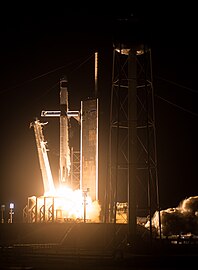 Launch of Crew-2
 -
 Crew Dragon C206 Endeavour approaching the ISS
 -
 View of the ISS from Endeavour
 -
 Crew-2 reentering the atmosphere
 -
 Crew Dragon Endeavour on MV GO Navigator after splashdown
.jpg)
.jpg)
.jpg)

.jpg)
.jpg)
See also
Notes
- ↑ 1.0 1.1 From an orbital dynamics perspective, the forward port is easier to approach, and therefore, new vehicles use this approach for their first docking. The Boeing Starliner was scheduled to make its first docking on OFT-2 at the end of July 2021; therefore, Crew-2 relocated to the zenith port to clear the forward port for OFT-2.[3][4]
References
- ↑ "Dragon Endeavour 2". NASA. April 26, 2021. https://nssdc.gsfc.nasa.gov/nmc/spacecraft/display.action?id=2021-030A. "Mass: 12055 kg"
- ↑ 2.0 2.1 "SpaceX's Crew-2 launch lights up the predawn sky with a spectacular show (photos)". April 23, 2021. https://www.space.com/spacex-crew-2-astronaut-launch-photos.
- ↑ "NASA TV to Air Crew Dragon Crew-2 Port Relocation on Space Station". NASA. June 14, 2021. https://www.nasa.gov/press-release/nasa-tv-to-air-crew-dragon-port-relocation-on-space-station.
 This article incorporates text from this source, which is in the public domain.
- ↑ "Starliner capsule fueled for unpiloted test flight to International Space Station". Spaceflight Now. June 22, 2021. https://spaceflightnow.com/2021/06/22/starliner-capsule-fueled-for-unpiloted-test-flight-to-international-space-station/.
- ↑ 5.0 5.1 Loff, Sarah (November 7, 2021). "NASA, SpaceX Adjust Crew-2 Station Departure Date". https://blogs.nasa.gov/crew-2/2021/11/07/nasa-spacex-adjust-crew-2-station-departure-date/. This article incorporates text from this source, which is in the public domain.
- ↑ Manchess, Gregory (April 21, 2021). "Dragon Crew Two Launch!". https://www.muddycolors.com/2021/04/dragon-crew-two-launch/.
- ↑ Kathleen Ellis (November 9, 2021). "Crew-2 Astronauts Safely Splash Down in Gulf of Mexico". NASA. https://blogs.nasa.gov/crew-2/2021/11/09/crew-2-astronauts-safely-splash-down-in-gulf-of-mexico/. Retrieved March 1, 2022.
- ↑ 8.0 8.1 "JAXA星出彰彦宇宙飛行士の国際宇宙ステーション(ISS)長期滞在 搭乗機決定について" (in ja). July 28, 2020. https://www.jaxa.jp/press/2020/07/20200728-1_j.html.
- ↑ 9.0 9.1 9.2 "Thomas Pesquet first ESA astronaut to ride a Dragon to space". ESA Science and Exploration. July 28, 2020. https://www.esa.int/Science_Exploration/Human_and_Robotic_Exploration/Thomas_Pesquet_first_ESA_astronaut_to_ride_a_Dragon_to_space//.
- ↑ Powell, Joel [@ShuttleAlmanac] (November 19, 2020). "JAXA has announced long stay visits to the ISS for 2022 and 2023". https://twitter.com/ShuttleAlmanac/status/1329610072368898048.
- ↑ Potter, Sean (March 5, 2021). "NASA, SpaceX Invite Media to Next Commercial Crew Launch". NASA. https://www.nasa.gov/press-release/nasa-spacex-invite-media-to-next-commercial-crew-launch. This article incorporates text from this source, which is in the public domain.
- ↑ Clark, Stephen (March 5, 2021). "Next Crew Dragon launch set for April 22". Spaceflight Now. https://spaceflightnow.com/2021/03/05/next-crew-dragon-launch-set-for-april-22/.
- ↑ Drake, Nadia (April 23, 2021). "SpaceX launches first astronauts on a reused rocket". National Geographic. https://www.nationalgeographic.com/science/article/spacex-launches-first-astronauts-on-a-reused-rocket.
- ↑ Thompson, Amy (April 23, 2021). "SpaceX launches 4 astronauts to space station, nails rocket landing". Space.com. https://www.space.com/spacex-crew-2-astronaut-launch-rocket-landing-success.
- ↑ "Megan to reuse Bob's demo-2 seat in crew-2 mission". April 20, 2020. https://www.aljazeera.com/news/2021/4/20/international-crew-recycled-capsule-spacex-prepares-to-launch.
- ↑ "Mission Timeline for Launch Thursday, April 23 at 5:49:02 EST". Spaceflight Now. https://spaceflightnow.com/2021/04/22/crew-2-mission-timeline/.
- ↑ Garcia, Mark (April 24, 2021). "NASA TV Covers SpaceX Crew-2 Docking to Station Today". https://blogs.nasa.gov/spacestation/2021/04/24/nasa-tv-covers-spacex-crew-2-docking-to-station-today/. This article incorporates text from this source, which is in the public domain.
- ↑ "SpaceX Crew Dragon Endeavour docks with ISS". April 24, 2021. https://www.france24.com/en/live-news/20210424-spacex-crew-dragon-endeavour-docks-with-iss-nasa-tv.
- ↑ Cawley, James (April 24, 2021). "Crew Dragon Docks to Station, Hatches Open Soon". https://blogs.nasa.gov/crew-2/2021/04/24/crew-dragon-docks-to-station-day-after-launch/. This article incorporates text from this source, which is in the public domain.
- ↑ Cawley, James (November 17, 2020). "Hatches Open, Crew Dragon Astronauts Join Expedition 64". https://blogs.nasa.gov/commercialcrew/2020/11/17/hatches-open-crew-dragon-astronauts-join-expedition-64/. This article incorporates text from this source, which is in the public domain.
- ↑ "SPACE SHUTTLE MUSIC". NASA. March 13, 2015. https://history.nasa.gov/wakeup%20calls.pdf.
- ↑ "Chronology of Wakeup Calls". NASA. August 2, 2005. https://history.nasa.gov/wakeup.htm. This article incorporates text from this source, which is in the public domain.
- ↑ @chasg76 (July 25, 2021). "@Explorer_Flight @Thom_astro...". https://twitter.com/chasg76/status/1419262730100432898.
- ↑ "SpaceX crew launch bumped to next week; astronaut on mend". AP News. November 4, 2021. https://apnews.com/article/space-exploration-science-business-weather-26ca18622d5779b79aeac5bc41392cbe.
- ↑ Clark, Stephen (November 9, 2021). "SpaceX crew capsule brings astronauts home after nearly 200 days in orbit – Spaceflight Now" (in en-US). https://spaceflightnow.com/2021/11/09/spacex-crew-capsule-brings-astronauts-home-after-nearly-200-days-in-orbit/.
| 1998–2004 |
|  | ||||||||||||||||||||||||||||||||||||||||||||||||||||||||
|---|---|---|---|---|---|---|---|---|---|---|---|---|---|---|---|---|---|---|---|---|---|---|---|---|---|---|---|---|---|---|---|---|---|---|---|---|---|---|---|---|---|---|---|---|---|---|---|---|---|---|---|---|---|---|---|---|---|---|
| 2005–2009 | ||||||||||||||||||||||||||||||||||||||||||||||||||||||||||
| 2010–2014 | ||||||||||||||||||||||||||||||||||||||||||||||||||||||||||
| 2015–2019 |
| |||||||||||||||||||||||||||||||||||||||||||||||||||||||||
| 2020–2024 | ||||||||||||||||||||||||||||||||||||||||||||||||||||||||||
| Individuals | ||||||||||||||||||||||||||||||||||||||||||||||||||||||||||
| Vehicles |
| |||||||||||||||||||||||||||||||||||||||||||||||||||||||||
Ongoing spaceflights in bold
! rowspan="3" colspan="2" width="14%" style="border-bottom:2px solid grey;" | Date/Time (UTC) ! Configuration ! Serial number ! Launch site ! Outcome |- |style="text-align:center;background-color:#e3e9e9;" | Payload |style="text-align:center;background-color:#e3e9e9;" | Separation orbit |style="text-align:center;background-color:#e3e9e9;" | Operator |style="text-align:center;background-color:#e3e9e9;" | Function |- | colspan="4" style="text-align:center;background-color:#e4dfdf;border-bottom:2px solid grey;" | Remarks |- Parameter 1=time required!
This is a navigational template created using {{navbox}}. It can be transcluded on pages by placing Initial visibilityThis template's initial visibility currently defaults to To change this template's initial visibility, the
Templates using the classes TemplateDataA navigational box that can be placed at the bottom of articles.
Template transclusions
 Not doneLatin pronunciation: [{{{1}}}] Not doneLatin pronunciation: [{{{1}}}]
| rowspan="1" colspan="2" style="border-top:2px solid #aabbcc;" | | style="border-top:2px solid #aabbcc;" | | style="border-top:2px solid #aabbcc;" | | style="border-top:2px solid #aabbcc;" | | style="border-top:2px solid #aabbcc;" | |- |- Vietnamese pronunciation: [{{{1}}}]-4500 — – -4000 — – -3500 — – -3000 — – -2500 — – -2000 — – -1500 — – -1000 — – -500 — – 0 —  Done Done To doRussian pronunciation: [{{{1}}}]Greek pronunciation: [{{{1}}}] To doRussian pronunciation: [{{{1}}}]Greek pronunciation: [{{{1}}}] Danish pronunciation: [{{{1}}}]Northern Sami pronunciation: [{{{1}}}]Mandarin pronunciation: [{{{ipa}}}]Cantonese pronunciation: [{{{1}}}]Entry from SpaceX Crew-2 from TCI Europe, retrieved on {{{Date}}} Danish pronunciation: [{{{1}}}]Northern Sami pronunciation: [{{{1}}}]Mandarin pronunciation: [{{{ipa}}}]Cantonese pronunciation: [{{{1}}}]Entry from SpaceX Crew-2 from TCI Europe, retrieved on {{{Date}}}
This is a navigational template created using {{navbox}}. It can be transcluded on pages by placing Initial visibilityThis template's initial visibility currently defaults to To change this template's initial visibility, the
Templates using the classes TemplateDataA navigational box that can be placed at the bottom of articles.
 In progressPalomares, M. L. D. and Pauly, D., eds. (2011). "{{{1}}} {{{2}}}" in SeaLifeBase. April 2011 version.Turkish pronunciation: [{{{1}}}]Finnish pronunciation: [{{{1}}}]Froese, Rainer and Pauly, Daniel, eds. (2006). "{{{1}}} {{{2}}}" in FishBase. April 2006 version. In progressPalomares, M. L. D. and Pauly, D., eds. (2011). "{{{1}}} {{{2}}}" in SeaLifeBase. April 2011 version.Turkish pronunciation: [{{{1}}}]Finnish pronunciation: [{{{1}}}]Froese, Rainer and Pauly, Daniel, eds. (2006). "{{{1}}} {{{2}}}" in FishBase. April 2006 version.
|- | ... | — | — | — | — | — | — |-Old Norse pronunciation: [{{{1}}}]Salish pronunciation: [{{{1}}}]Basque pronunciation: [{{{1}}}]{{{1}}}data-sort-value="" style="background: #ececec; color: #2C2C2C; vertical-align: middle; font-size: smaller; text-align: center; " class="table-na" | UnreleasedNorwegian pronunciation: [{{{1}}}] (aged {{{4}}})Hungarian pronunciation: [{{{1}}}]Quechua pronunciation: [{{{1}}}]Arabic pronunciation: [{{{1}}}]Punjabi pronunciation: [{{{1}}}]Afrikaans pronunciation: [{{{1}}}]Romanian pronunciation: [{{{1}}}]Hebrew pronunciation: [{{{1}}}][INVALID OR MISSING PARAMETER IN TEMPLATE SpaceX Crew-2]Uto-Aztecan pronunciation: [{{{1}}}]Tamil pronunciation: [{{{1}}}]Hindustani pronunciation: [{{{1}}}]Swedish pronunciation: [{{{1}}}]Kazakh pronunciation: [{{{1}}}]Lao pronunciation: [{{{1}}}]Tibetan pronunciation: [{{{1}}}]Khmer pronunciation: [{{{1}}}]data-sort-value="" style="vertical-align:middle; text-align:center" class="table-na" | —{{{1}}}Welsh pronunciation: [{{{1}}}] Partially doneAthabaskan pronunciation: [{{{1}}}]Māori pronunciation: [{{{1}}}]IPA: [{{{1}}}]Bulgarian pronunciation: [{{{1}}}]Korean pronunciation: [{{{1}}}]Icelandic pronunciation: [{{{1}}}]Sanskrit pronunciation: [{{{1}}}]Bengali pronunciation: [{{{1}}}]Indonesian pronunciation: [{{{1}}}]Serbo-Croatian pronunciation: [{{{1}}}]CROSBI {{{1}}} Future spaceflights in italics Partially doneAthabaskan pronunciation: [{{{1}}}]Māori pronunciation: [{{{1}}}]IPA: [{{{1}}}]Bulgarian pronunciation: [{{{1}}}]Korean pronunciation: [{{{1}}}]Icelandic pronunciation: [{{{1}}}]Sanskrit pronunciation: [{{{1}}}]Bengali pronunciation: [{{{1}}}]Indonesian pronunciation: [{{{1}}}]Serbo-Croatian pronunciation: [{{{1}}}]CROSBI {{{1}}} Future spaceflights in italics
! rowspan="3" colspan="2" width="14%" style="border-bottom:2px solid grey;" | Date/Time (UTC) ! Configuration ! Serial number ! Launch site ! Outcome |- |style="text-align:center;background-color:#e3e9e9;" | Payload |style="text-align:center;background-color:#e3e9e9;" | Separation orbit |style="text-align:center;background-color:#e3e9e9;" | Operator |style="text-align:center;background-color:#e3e9e9;" | Function |- | colspan="4" style="text-align:center;background-color:#e4dfdf;border-bottom:2px solid grey;" | Remarks |- Parameter 1=time required!
This is a navigational template created using {{navbox}}. It can be transcluded on pages by placing Initial visibilityThis template's initial visibility currently defaults to To change this template's initial visibility, the
Templates using the classes TemplateDataA navigational box that can be placed at the bottom of articles.
Template transclusions
Not doneLatin pronunciation: [{{{1}}}]
| rowspan="1" colspan="2" style="border-top:2px solid #aabbcc;" | | style="border-top:2px solid #aabbcc;" | | style="border-top:2px solid #aabbcc;" | | style="border-top:2px solid #aabbcc;" | | style="border-top:2px solid #aabbcc;" | |- |- Vietnamese pronunciation: [{{{1}}}]-4500 — – -4000 — – -3500 — – -3000 — – -2500 — – -2000 — – -1500 — – -1000 — – -500 — – 0 — Done To doRussian pronunciation: [{{{1}}}]Greek pronunciation: [{{{1}}}]Danish pronunciation: [{{{1}}}]Northern Sami pronunciation: [{{{1}}}]Mandarin pronunciation: [{{{ipa}}}]Cantonese pronunciation: [{{{1}}}]Entry from SpaceX Crew-2 from TCI Europe, retrieved on {{{Date}}}
This is a navigational template created using {{navbox}}. It can be transcluded on pages by placing Initial visibilityThis template's initial visibility currently defaults to To change this template's initial visibility, the
Templates using the classes TemplateDataA navigational box that can be placed at the bottom of articles.
In progressPalomares, M. L. D. and Pauly, D., eds. (2011). "{{{1}}} {{{2}}}" in SeaLifeBase. April 2011 version.Turkish pronunciation: [{{{1}}}]Finnish pronunciation: [{{{1}}}]Froese, Rainer and Pauly, Daniel, eds. (2006). "{{{1}}} {{{2}}}" in FishBase. April 2006 version.
|- | ... | — | — | — | — | — | — |-Old Norse pronunciation: [{{{1}}}]Salish pronunciation: [{{{1}}}]Basque pronunciation: [{{{1}}}]{{{1}}}data-sort-value="" style="background: #ececec; color: #2C2C2C; vertical-align: middle; font-size: smaller; text-align: center; " class="table-na" | UnreleasedNorwegian pronunciation: [{{{1}}}] (aged {{{4}}})Hungarian pronunciation: [{{{1}}}]Quechua pronunciation: [{{{1}}}]Arabic pronunciation: [{{{1}}}]Punjabi pronunciation: [{{{1}}}]Afrikaans pronunciation: [{{{1}}}]Romanian pronunciation: [{{{1}}}]Hebrew pronunciation: [{{{1}}}][INVALID OR MISSING PARAMETER IN TEMPLATE SpaceX Crew-2]Uto-Aztecan pronunciation: [{{{1}}}]Tamil pronunciation: [{{{1}}}]Hindustani pronunciation: [{{{1}}}]Swedish pronunciation: [{{{1}}}]Kazakh pronunciation: [{{{1}}}]Lao pronunciation: [{{{1}}}]Tibetan pronunciation: [{{{1}}}]Khmer pronunciation: [{{{1}}}]data-sort-value="" style="vertical-align:middle; text-align:center" class="table-na" | —{{{1}}}Welsh pronunciation: [{{{1}}}] Partially doneAthabaskan pronunciation: [{{{1}}}]Māori pronunciation: [{{{1}}}]IPA: [{{{1}}}]Bulgarian pronunciation: [{{{1}}}]Korean pronunciation: [{{{1}}}]Icelandic pronunciation: [{{{1}}}]Sanskrit pronunciation: [{{{1}}}]Bengali pronunciation: [{{{1}}}]Indonesian pronunciation: [{{{1}}}]Serbo-Croatian pronunciation: [{{{1}}}]CROSBI {{{1}}} † - mission failed to reach ISS | ||||||||||||||||||||||||||||||||||||||||||||||||||||||||||


| Past missions |
|  |
|---|---|---|
| Future missions |
| |
| See also | ||
| ||

| General |  .jpg)  .jpg) | ||||||
|---|---|---|---|---|---|---|---|
| Facilities | |||||||
| Earth-based research | |||||||
| Spacecraft used |
| ||||||
| Mission highlights |
| ||||||
 |  |


