Engineering:SpaceX Crew-5
.jpg) Endurance launches to the ISS with Crew-5 onboard | |
| Names | USCV-5 |
|---|---|
| Mission type | ISS crew transport |
| Operator | SpaceX |
| Mission duration | 157 days, 10 hours, 1 minute[1] |
| Spacecraft properties | |
| Spacecraft | Crew Dragon |
| Spacecraft type | Crew Dragon |
| Manufacturer | SpaceX |
| Launch mass | 12,519 kg (27,600 lb) |
| Landing mass | 9,616 kg (21,200 lb) |
| Crew | |
| Crew size | 4 |
| Members |
|
| Expedition | Expedition 68 |
| Start of mission | |
| Launch date | October 5, 2022, 16:00:57 UTC (12:00:57 pm EDT)[3] |
| Rocket | Falcon 9 Block 5 B1077-1 |
| Launch site | Kennedy, LC‑39A |
| End of mission | |
| Recovered by | MV Shannon |
| Landing date | March 12, 2023, 02:02 UTC (9:02 pm EST)[4] |
| Landing site | Gulf of Mexico, near Clearwater, Florida |
| Orbital parameters | |
| Reference system | Geocentric orbit |
| Regime | Low Earth orbit |
| Inclination | 51.68° |
| Docking with ISS | |
| Docking port | Harmony forward |
| Docking date | October 6, 2022, 21:01 UTC |
| Undocking date | March 11, 2023, 07:20 UTC |
| Time docked | 155 days, 10 hours, 19 minutes |
 Mission patch  From left: Kikina, Cassada, Mann and Wakata | |
SpaceX Crew-5 was the fifth operational NASA Commercial Crew Program flight of a Crew Dragon spacecraft, and the eighth overall crewed orbital flight. The mission was successfully launched on October 5, 2022, with the aim of transporting four crew members to the International Space Station (ISS). The Crew Dragon spacecraft docked at the ISS on October 6, 2022, at 21:01 UTC.
The crew for this mission comprised two NASA astronauts, one JAXA astronaut, and one Russian cosmonaut. Three of the crew members were assigned to this mission due to delays in Boeing's Starliner program. Commander Nicole Mann was reassigned from Boeing's Boe-CFT mission, while pilot Josh Cassada and mission specialist Koichi Wakata transferred from Boeing Starliner-1.[5][6] Anna Kikina was reassigned from Soyuz MS-22.
Among the crew members, three were embarking on their first spaceflight, while mission specialist Koichi Wakata is a veteran of four previous spaceflights.
Crew
This mission marked a significant milestone as it was the first time a Russian cosmonaut, Anna Kikina, flew aboard a Crew Dragon spacecraft. In July 2022, Kikina was selected to participate in the mission as part of the Soyuz-Dragon crew swap system. This system ensures that each crew rotation mission includes at least one NASA astronaut and one Roscosmos cosmonaut, allowing both countries to maintain a presence on the International Space Station (ISS) and the ability to sustain their respective systems in case one of the vehicles, either Soyuz or commercial crew, is grounded for an extended period.[7]
Including Kikina in the Crew Dragon mission ensured that both NASA and Roscosmos continued to have representation on the ISS. Additionally, this mission marked the first instance since STS-113, when Nikolai Budarin flew, that a Russian cosmonaut flew on a U.S. spacecraft. It also represented the first launch of a Russian cosmonaut aboard a U.S. space capsule.[2]
The Russian authorities approved the seat exchange between the American and Russian astronauts in June 2022, allowing for this historic collaboration between the two space agencies.[8]
| Position | Astronaut | |
|---|---|---|
| Commander | Nicole Aunapu Mann, NASA Expedition 68 First spaceflight | |
| Pilot | Josh A. Cassada, NASA Expedition 68 Only spaceflight | |
| Mission specialist | Koichi Wakata, JAXA Expedition 68 Fifth spaceflight | |
| Mission specialist | Anna Kikina, Roscosmos Expedition 68 First spaceflight | |
Backup for Soyuz MS-22 Crew Return
A micro-meteorite punctured a 0.8 mm diameter (0.031 in) hole in the radiator of Soyuz MS-22,[9] raising doubts over its safety. As a result, it was replaced with Soyuz MS-23, launched uncrewed on February 24, 2023.[10][11]
Until the replacement MS-23 docked to ISS, SpaceX Crew-5 was considered among the options to return the MS-22 crew in case of emergency. SpaceX originally designed Crew Dragon to host a crew of seven at a time. The International Space Station mission management team decided to move NASA astronaut Francisco Rubio's Soyuz seat liner from the Soyuz MS-22 spacecraft to Dragon Endurance to provide lifeboat capabilities in the event Rubio needed to return to Earth because of an emergency evacuation from the space station. The seat liner was moved on January 17, 2023, with installation and configuration continuing the following day. Seat liners have been swapped between two Soyuz, but this was the first time for Soyuz to Crew Dragon. The change allowed for increased crew protection by reducing the heat load inside the MS-22 spacecraft for cosmonauts Sergey Prokopyev and Dmitry Petelin in the event of an emergency return to Earth. The SpaceX Crew-6 space capsule is designed to bring back crew serving as an emergency evacuation option after Crew-5.[12]
As MS-23 arrived at the space station on February 26, Rubio's seat liner was transferred to the new Soyuz on March 6, and the seat liners for Prokopyev and Petelin were moved from MS-22 to MS-23 on March 2 ahead of their return in the Soyuz.[13]
Gallery
-
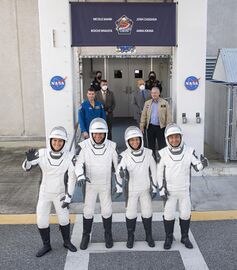 Crew-5 astronauts prior to launch
 -
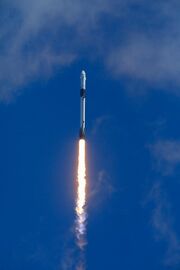 Crew-5 launch
 -
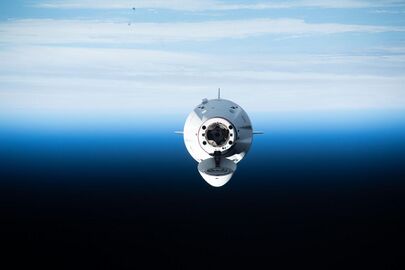 Crew-5 approaching the ISS
 -
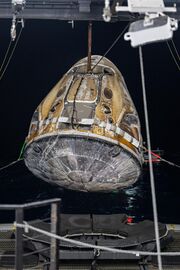 Crew-5 recovery after reentry and landing
.jpg)
.jpeg)

.jpg)
References
- ↑ "SpaceX F9 / Crew Dragon : Crew-5 : KSC LC-39A : NET 5 Oct 2022 (16:00:57 UTC)". https://forum.nasaspaceflight.com/index.php?topic=54927.msg2414814#msg2414814.
- ↑ 2.0 2.1 Zak, Anatoly [@RussianSpaceWeb] (May 20, 2022). "Roscosmos head hinted yesterday that crossover flights to #ISS, including launch of Russian cosmonaut Anna Kikina on the US Crew Dragon, would proceed as scheduled.". https://twitter.com/RussianSpaceWeb/status/1527661669341614082.
- ↑ Clark, Stephen (September 28, 2022). "SpaceX, ULA postpone launches as Hurricane Ian moves toward Florida". Spaceflight Now. https://spaceflightnow.com/2022/09/28/spacex-ula-postpone-launches-as-hurricane-ian-threatens-florida/.
- ↑ "NASA's SpaceX Crew-5 Splash Down Near Florida Coast, Safe on Earth". NASA (Press release). March 11, 2023. Retrieved March 30, 2023.
- ↑ "NASA Announces Astronaut Changes for Upcoming Commercial Crew Missions" (Press release). NASA. October 6, 2021. Retrieved October 6, 2021.
 This article incorporates text from this source, which is in the public domain.
- ↑ @jaxa_wdc (October 12, 2021). "JAXA has announced their WAKATA Koichi @Astro_Wakata is headed for the International Space Station aboard SpaceX's…". https://twitter.com/jaxa_wdc/status/1447753014777810947.
- ↑ Foust, Jeff (October 26, 2021). "Rogozin says Crew Dragon safe for Russian cosmonauts". SpaceNews. https://spacenews.com/rogozin-says-crew-dragon-safe-for-russian-cosmonauts/.
- ↑ "Распоряжение Правительства Российской Федерации от 10.06.2022 № 1532-р ∙ Официальное опубликование правовых актов ∙ Официальный интернет-портал правовой информации" (in ru). June 10, 2022. http://publication.pravo.gov.ru/Document/View/0001202206100047.
- ↑ "Госкорпорация «Роскосмос»" (in ru). https://t.me/roscosmos_gk/8000.
- ↑ Pavlushchenko, Katya [@katlinegrey] (December 19, 2022). "A big update on the incident with #SoyuzMS22 appeared on the Roscosmos website: t.co/cJGMOhh9Xr. Quick summary in the thread below. ⤵️ t.co/Gj1SCTG49j" (in en). https://twitter.com/katlinegrey/status/1604818480259366912.
- ↑ Gray, Tyler (February 25, 2023). "Uncrewed Soyuz MS-23 "rescue" mission arrives at ISS". https://www.nasaspaceflight.com/2023/02/soyuz-ms-23-launch/.
- ↑ NASA Video (January 25, 2023). Expedition 68 NASA's SpaceX Crew-6 Leaders Discuss Mission - Jan. 25, 2023. Retrieved February 14, 2023 – via YouTube.
- ↑ Garcia, Mark. "Spacewalk Preps Continue as Soyuz Seat Move Planned as Precaution" (in en-US). https://blogs.nasa.gov/spacestation/2023/01/13/spacewalk-preps-continue-as-soyuz-seat-move-planned-as-precaution/. This article incorporates text from this source, which is in the public domain.
| 1998–2004 |
|  | ||||||||||||||||||||||||||||||||||||||||||||||||||||||||
|---|---|---|---|---|---|---|---|---|---|---|---|---|---|---|---|---|---|---|---|---|---|---|---|---|---|---|---|---|---|---|---|---|---|---|---|---|---|---|---|---|---|---|---|---|---|---|---|---|---|---|---|---|---|---|---|---|---|---|
| 2005–2009 | ||||||||||||||||||||||||||||||||||||||||||||||||||||||||||
| 2010–2014 | ||||||||||||||||||||||||||||||||||||||||||||||||||||||||||
| 2015–2019 |
| |||||||||||||||||||||||||||||||||||||||||||||||||||||||||
| 2020–2024 | ||||||||||||||||||||||||||||||||||||||||||||||||||||||||||
| Individuals | ||||||||||||||||||||||||||||||||||||||||||||||||||||||||||
| Vehicles |
| |||||||||||||||||||||||||||||||||||||||||||||||||||||||||
Ongoing spaceflights in bold
! rowspan="3" colspan="2" width="14%" style="border-bottom:2px solid grey;" | Date/Time (UTC) ! Configuration ! Serial number ! Launch site ! Outcome |- |style="text-align:center;background-color:#e3e9e9;" | Payload |style="text-align:center;background-color:#e3e9e9;" | Separation orbit |style="text-align:center;background-color:#e3e9e9;" | Operator |style="text-align:center;background-color:#e3e9e9;" | Function |- | colspan="4" style="text-align:center;background-color:#e4dfdf;border-bottom:2px solid grey;" | Remarks |- Parameter 1=time required!
This is a navigational template created using {{navbox}}. It can be transcluded on pages by placing Initial visibilityThis template's initial visibility currently defaults to To change this template's initial visibility, the
Templates using the classes TemplateDataA navigational box that can be placed at the bottom of articles.
Template transclusions
 Not doneLatin pronunciation: [{{{1}}}] Not doneLatin pronunciation: [{{{1}}}]
| rowspan="1" colspan="2" style="border-top:2px solid #aabbcc;" | | style="border-top:2px solid #aabbcc;" | | style="border-top:2px solid #aabbcc;" | | style="border-top:2px solid #aabbcc;" | | style="border-top:2px solid #aabbcc;" | |- |- Vietnamese pronunciation: [{{{1}}}]-4500 — – -4000 — – -3500 — – -3000 — – -2500 — – -2000 — – -1500 — – -1000 — – -500 — – 0 —  Done Done To doRussian pronunciation: [{{{1}}}]Greek pronunciation: [{{{1}}}] To doRussian pronunciation: [{{{1}}}]Greek pronunciation: [{{{1}}}] Danish pronunciation: [{{{1}}}]Northern Sami pronunciation: [{{{1}}}]Mandarin pronunciation: [{{{ipa}}}]Cantonese pronunciation: [{{{1}}}]Entry from SpaceX Crew-5 from TCI Europe, retrieved on {{{Date}}} Danish pronunciation: [{{{1}}}]Northern Sami pronunciation: [{{{1}}}]Mandarin pronunciation: [{{{ipa}}}]Cantonese pronunciation: [{{{1}}}]Entry from SpaceX Crew-5 from TCI Europe, retrieved on {{{Date}}}
This is a navigational template created using {{navbox}}. It can be transcluded on pages by placing Initial visibilityThis template's initial visibility currently defaults to To change this template's initial visibility, the
Templates using the classes TemplateDataA navigational box that can be placed at the bottom of articles.
 In progressPalomares, M. L. D. and Pauly, D., eds. (2011). "{{{1}}} {{{2}}}" in SeaLifeBase. April 2011 version.Turkish pronunciation: [{{{1}}}]Finnish pronunciation: [{{{1}}}]Froese, Rainer and Pauly, Daniel, eds. (2006). "{{{1}}} {{{2}}}" in FishBase. April 2006 version. In progressPalomares, M. L. D. and Pauly, D., eds. (2011). "{{{1}}} {{{2}}}" in SeaLifeBase. April 2011 version.Turkish pronunciation: [{{{1}}}]Finnish pronunciation: [{{{1}}}]Froese, Rainer and Pauly, Daniel, eds. (2006). "{{{1}}} {{{2}}}" in FishBase. April 2006 version.
|- | ... | — | — | — | — | — | — |-Old Norse pronunciation: [{{{1}}}]Salish pronunciation: [{{{1}}}]Basque pronunciation: [{{{1}}}]{{{1}}}data-sort-value="" style="background: #ececec; color: #2C2C2C; vertical-align: middle; font-size: smaller; text-align: center; " class="table-na" | UnreleasedNorwegian pronunciation: [{{{1}}}] (aged {{{4}}})Hungarian pronunciation: [{{{1}}}]Quechua pronunciation: [{{{1}}}]Arabic pronunciation: [{{{1}}}]Punjabi pronunciation: [{{{1}}}]Afrikaans pronunciation: [{{{1}}}]Romanian pronunciation: [{{{1}}}]Hebrew pronunciation: [{{{1}}}][INVALID OR MISSING PARAMETER IN TEMPLATE SpaceX Crew-5]Uto-Aztecan pronunciation: [{{{1}}}]Tamil pronunciation: [{{{1}}}]Hindustani pronunciation: [{{{1}}}]Swedish pronunciation: [{{{1}}}]Kazakh pronunciation: [{{{1}}}]Lao pronunciation: [{{{1}}}]Tibetan pronunciation: [{{{1}}}]Khmer pronunciation: [{{{1}}}]data-sort-value="" style="vertical-align:middle; text-align:center" class="table-na" | —{{{1}}}Welsh pronunciation: [{{{1}}}] Partially doneAthabaskan pronunciation: [{{{1}}}]Māori pronunciation: [{{{1}}}]IPA: [{{{1}}}]Bulgarian pronunciation: [{{{1}}}]Korean pronunciation: [{{{1}}}]Icelandic pronunciation: [{{{1}}}]Sanskrit pronunciation: [{{{1}}}]Bengali pronunciation: [{{{1}}}]Indonesian pronunciation: [{{{1}}}]Serbo-Croatian pronunciation: [{{{1}}}]CROSBI {{{1}}} Future spaceflights in italics Partially doneAthabaskan pronunciation: [{{{1}}}]Māori pronunciation: [{{{1}}}]IPA: [{{{1}}}]Bulgarian pronunciation: [{{{1}}}]Korean pronunciation: [{{{1}}}]Icelandic pronunciation: [{{{1}}}]Sanskrit pronunciation: [{{{1}}}]Bengali pronunciation: [{{{1}}}]Indonesian pronunciation: [{{{1}}}]Serbo-Croatian pronunciation: [{{{1}}}]CROSBI {{{1}}} Future spaceflights in italics
! rowspan="3" colspan="2" width="14%" style="border-bottom:2px solid grey;" | Date/Time (UTC) ! Configuration ! Serial number ! Launch site ! Outcome |- |style="text-align:center;background-color:#e3e9e9;" | Payload |style="text-align:center;background-color:#e3e9e9;" | Separation orbit |style="text-align:center;background-color:#e3e9e9;" | Operator |style="text-align:center;background-color:#e3e9e9;" | Function |- | colspan="4" style="text-align:center;background-color:#e4dfdf;border-bottom:2px solid grey;" | Remarks |- Parameter 1=time required!
This is a navigational template created using {{navbox}}. It can be transcluded on pages by placing Initial visibilityThis template's initial visibility currently defaults to To change this template's initial visibility, the
Templates using the classes TemplateDataA navigational box that can be placed at the bottom of articles.
Template transclusions
Not doneLatin pronunciation: [{{{1}}}]
| rowspan="1" colspan="2" style="border-top:2px solid #aabbcc;" | | style="border-top:2px solid #aabbcc;" | | style="border-top:2px solid #aabbcc;" | | style="border-top:2px solid #aabbcc;" | | style="border-top:2px solid #aabbcc;" | |- |- Vietnamese pronunciation: [{{{1}}}]-4500 — – -4000 — – -3500 — – -3000 — – -2500 — – -2000 — – -1500 — – -1000 — – -500 — – 0 — Done To doRussian pronunciation: [{{{1}}}]Greek pronunciation: [{{{1}}}]Danish pronunciation: [{{{1}}}]Northern Sami pronunciation: [{{{1}}}]Mandarin pronunciation: [{{{ipa}}}]Cantonese pronunciation: [{{{1}}}]Entry from SpaceX Crew-5 from TCI Europe, retrieved on {{{Date}}}
This is a navigational template created using {{navbox}}. It can be transcluded on pages by placing Initial visibilityThis template's initial visibility currently defaults to To change this template's initial visibility, the
Templates using the classes TemplateDataA navigational box that can be placed at the bottom of articles.
In progressPalomares, M. L. D. and Pauly, D., eds. (2011). "{{{1}}} {{{2}}}" in SeaLifeBase. April 2011 version.Turkish pronunciation: [{{{1}}}]Finnish pronunciation: [{{{1}}}]Froese, Rainer and Pauly, Daniel, eds. (2006). "{{{1}}} {{{2}}}" in FishBase. April 2006 version.
|- | ... | — | — | — | — | — | — |-Old Norse pronunciation: [{{{1}}}]Salish pronunciation: [{{{1}}}]Basque pronunciation: [{{{1}}}]{{{1}}}data-sort-value="" style="background: #ececec; color: #2C2C2C; vertical-align: middle; font-size: smaller; text-align: center; " class="table-na" | UnreleasedNorwegian pronunciation: [{{{1}}}] (aged {{{4}}})Hungarian pronunciation: [{{{1}}}]Quechua pronunciation: [{{{1}}}]Arabic pronunciation: [{{{1}}}]Punjabi pronunciation: [{{{1}}}]Afrikaans pronunciation: [{{{1}}}]Romanian pronunciation: [{{{1}}}]Hebrew pronunciation: [{{{1}}}][INVALID OR MISSING PARAMETER IN TEMPLATE SpaceX Crew-5]Uto-Aztecan pronunciation: [{{{1}}}]Tamil pronunciation: [{{{1}}}]Hindustani pronunciation: [{{{1}}}]Swedish pronunciation: [{{{1}}}]Kazakh pronunciation: [{{{1}}}]Lao pronunciation: [{{{1}}}]Tibetan pronunciation: [{{{1}}}]Khmer pronunciation: [{{{1}}}]data-sort-value="" style="vertical-align:middle; text-align:center" class="table-na" | —{{{1}}}Welsh pronunciation: [{{{1}}}] Partially doneAthabaskan pronunciation: [{{{1}}}]Māori pronunciation: [{{{1}}}]IPA: [{{{1}}}]Bulgarian pronunciation: [{{{1}}}]Korean pronunciation: [{{{1}}}]Icelandic pronunciation: [{{{1}}}]Sanskrit pronunciation: [{{{1}}}]Bengali pronunciation: [{{{1}}}]Indonesian pronunciation: [{{{1}}}]Serbo-Croatian pronunciation: [{{{1}}}]CROSBI {{{1}}} † - mission failed to reach ISS | ||||||||||||||||||||||||||||||||||||||||||||||||||||||||||


| Past missions |
|  |
|---|---|---|
| Future missions |
| |
| See also | ||
| ||

 |  |


